
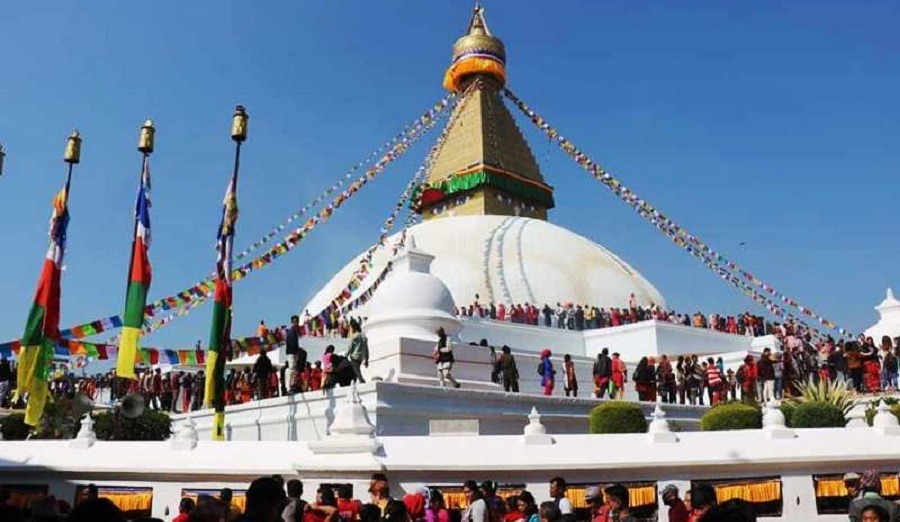
If you were to search for Chaitra Purne Jatra in a museum or cultural centre, you would likely find nothing. No canvases depict it, no sculptures commemorate it, and no artefacts displayed behind glass speak to its significance. Yet every year, on the full moon night of Chaitra, falling somewhere between late March and early April, thousands of Tamang people from across Nepal and beyond converge upon the sacred sites of Namobuddha, Boudha, and Swayambhu to perform one of the most profound ritual traditions in the Himalayan cultural landscape.
They walk through the night. They light lamps for the departed. They sing songs passed down for generations. And by the time the full moon sets, they have completed a ritual journey that connects them not just to their ancestors, but to one of the oldest sacred stories this landscape holds.
This is Chaitra Purne Jatra, also widely known as Temal Jatra. The absence of material documentation is not an oversight. It reflects the very nature of this heritage. This festival is, in the fullest sense of the term, intangible. It leaves no material trace. It exists fully in practice, in movement, in repetition, and in collective memory.
The UNESCO Convention for the Safeguarding of the Intangible Cultural Heritage (2003) defines traditions exactly like this, ones transmitted not through written or material collections, but through the practices, representations, expressions, knowledge, and skills that communities recognise as part of their cultural heritage, transmitted from generation to generation, continuously recreated in response to their environment, and providing them with a sense of identity and continuity.
Chaitra Purne Jatra embodies each of these qualities. It passes down not through written instruction or institutional archives but through the body, through the act of walking, circling, spinning, lighting, singing, and gathering, and communities renew it year after year through collective participation. While the jatra has not yet been inscribed on any formal festival list, it deserves far wider recognition than it currently receives.
A Festival Rooted in Sacred Myth
To understand Chaitra Purne Jatra, one must begin not with ritual procedure but with myth, because the jatra, like all enduring cultural practices, draws its authority from a cosmological narrative.
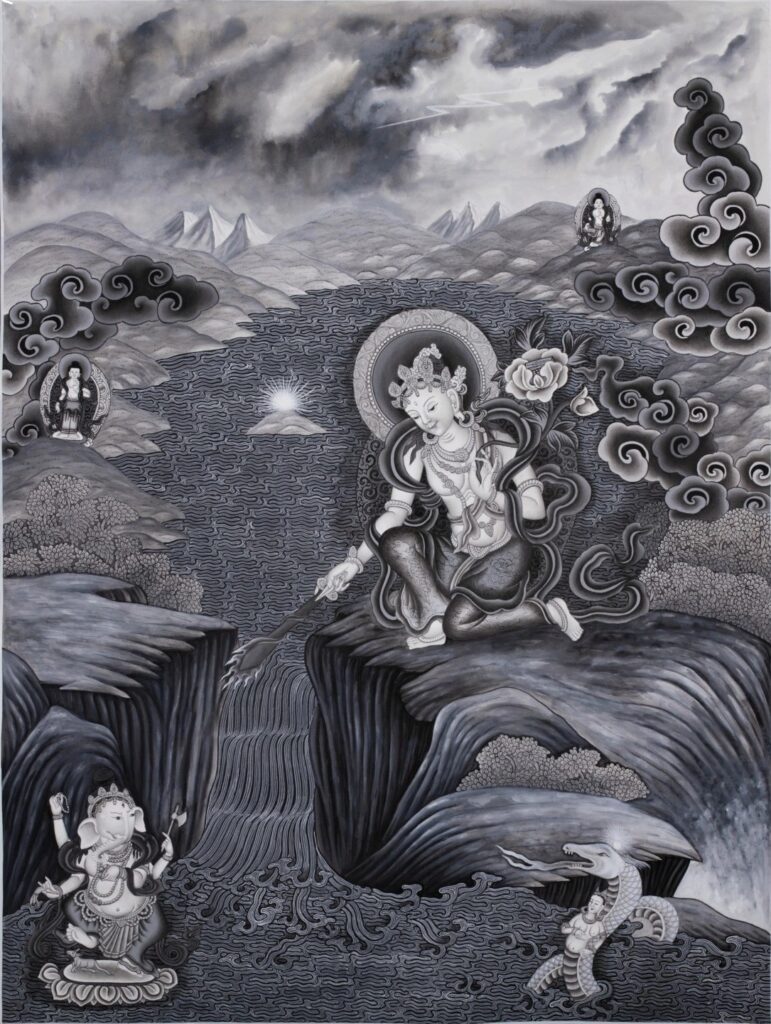
According to oral tradition, the valley was once a vast lake. The ancient Buddha Bipaswi visited the site, and on the full moon day of Chaitra, he sowed a lotus seed into the water from his seat on Nagarjuna Hill, the very hill where the Jamacho shrine stands today. Six months later, on the full moon of Ashwin, the lotus bloomed on the surface of the lake. From within it, a stupa in the form of pure light arose, shining, as the Swayambhu Purana describes it, like a thousand suns. This self-originated flame became known as Swayambhu, meaning “the self-created.”
Word of the sacred flame spread far beyond the valley. The Bodhisattva Manjushree travelled from his home on the Five-Peaked Mountain in China to pay his respects to Swayambhu. Seeing the jyotirupa, he cut open the southern rim of the valley at what is now the Chobar gorge to drain the lake and enable people to traverse and pay homage to the radiant light. According to oral tradition, it was the Tamang people who came first to pay respect.
This origin myth binds the jatra to the founding of one of the most sacred Buddhist sites in the Himalayan world and gives the annual pilgrimage its cosmological legitimacy.
The second story centres on Boudha. When the great Boudha Stupa was completed, the people of the twelve Temal kingdoms, the cluster of Tamang principalities, came together to celebrate its completion. That original gathering is remembered in the Tamang oral tradition as the founding moment of the communal celebration at Boudha. Centuries later, when the stupa fell into disrepair, a king named Rinzin Dorje Bal, the last ruler of the Timal kingdom in present-day Kavre district, sponsored its reconstruction. After the work was complete, he formally reinstated the pilgrimage to Boudha on Chaitra Purnima, asking his people to light butter lamps in memory of their deceased relatives. He gave the ancient tradition new life and institutional form. That single act of royal devotion became the seed of an organised communal tradition that his people have carried forward ever since.
How the Jatra Unfolds
What makes Chaitra Purne Jatra different from a simple pilgrimage is its profoundly performative character. The ritual does not unfold as a private or static devotional act. It unfolds as a structured, choreographed, and collectively inhabited sequence of actions, and this quality makes it particularly valuable as an object of cultural and scholarly attention.
The pilgrimage moves through three sacred sites: Boudha and Swayambhu in Kathmandu and Namobuddha in Kavre district. This trajectory is not simply geographical. Each stage of the journey represents a ritual transformation: participants separate themselves from ordinary life on the day before the pilgrimage, enter a liminal state as they perform their rites at the sacred stupas, and only reintegrate into everyday social life after completing the full sequence. The jatra functions as a passage, not merely through physical space but through states of being.
The jatra on Chaturdashi, the evening before the full moon, when pilgrims start arriving at the Boudha Stupa in Kathmandu. Worshippers circumambulate the stupa clockwise, spinning the manes, the small prayer wheels set into the surrounding wall, as they walk. They then pay homage to Majyajima, the revered figure credited with the stupa’s construction, at the southern side. While doing so, they light Chhomi, butter lamps, for relatives who have recently departed, to brighten what tradition calls the dark path of the deceased. Alongside monks gather families for a ceremony called Ngowa Monlam, a collective prayer directed specifically toward the peace and salvation of departed souls. The names of the dead come forward. The grief of the living and the passage of the dead meet in the same breath. For many families, this moment, structured in the middle of the crowded stupa, is the emotional heart of the entire jatra.
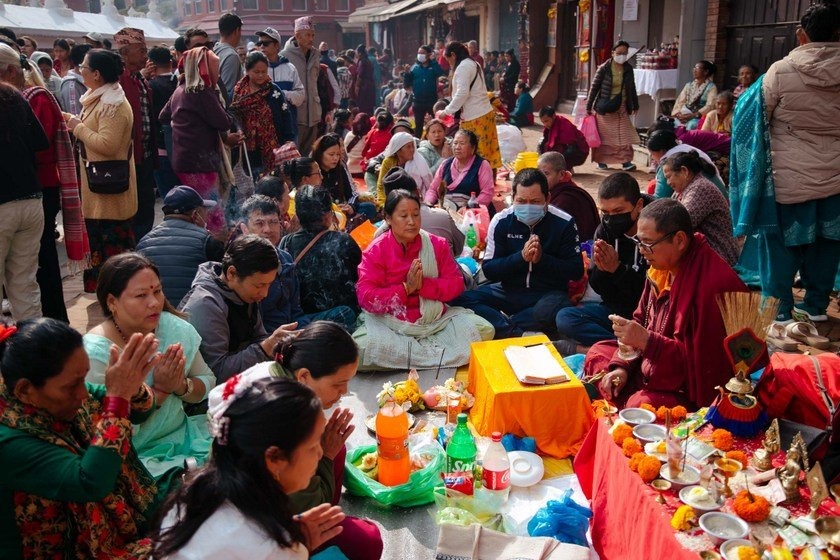
And then they sing. In groups, pilgrims walk and sing Phapare Geet, Tamang folk songs that carry devotion and longing and the particular ache of remembering someone who is no longer there. The damphu beats through the night. Nobody performs for an audience. People sing because the occasion asks it of them, and because some feelings need a voice more than they need a prayer.
As dawn breaks on the morning of the full moon, pilgrims leave Boudha and walk to Balaju on the northwestern edge of Kathmandu. At the Baisdhara, a long pool fed by twenty-two carved stone water spouts, they take a ritual bath. Tradition holds that the water at Baisdhara connects to the sacred Trisuli River on this one day each year. The bath washes away what the night has carried and prepares the body and spirit for what comes next.
From Balaju, the pilgrims climb to Swayambhu Mahachaitya. The rituals repeat again: circumambulation, lamps, and prayer. But the atmosphere at Swayambhu feels different from the solemn night at Boudha. By now thousands of people fill the hill and the courtyard below. Food stalls, book stalls, cultural exhibitions, and live music fill the space alongside the ancient rituals. Old friends find each other. Families who have come from different districts, or returned from years abroad, sit together on the steps. The sacred site becomes a reunion, and the reunion becomes part of the ritual.
Some pilgrims also climb to Jamacho, the summit shrine on Nagarjun hill where Bipaswi Buddha once sat, as well as to Namobuddha. It is believed that visiting Boudha, Swayambhu, and Namobuddha on the same day earns great merit.
More than a Religious Ritual
In Vajrayana Buddhism, the soul undergoes rebirth within 49 days of death. By that measure, the rituals performed during Chaitra Purne, especially the lighting of lamps for the departed, take place long after that process has already concluded. Doctrinally speaking, the ritual should not be necessary.
Yet the practice continues, year after year.
Scholars like David Holmberg who have studied Tamang communities closely note that ritual life does not always follow doctrine strictly. Instead, it adapts. Tamang lamas and practitioners have historically shaped rituals in ways that respond to social and emotional needs, rather than theological timelines alone.
This makes it clear that Chaitra Purne Jatra is not only about religious correctness. It is also about meaning. The ritual creates space for remembrance, for grief, and for gathering. It allows families and communities to reaffirm their connection to those who came before. The act of lighting a lamp does not depend on where the soul is believed to be. Its significance lives in the act itself, and in what it holds for the living.
This kind of gap between doctrine and practice exists in many traditions. What it shows is that rituals endure not simply because belief prescribes them, but because human need sustains them. In that sense, Chaitra Purne Jatra reflects the very essence of intangible heritage, kept alive through participation, memory, and the human need to stay connected across generations.
The Songs that Carry Memory
Of all the elements of Chaitra Purne Jatra, the one most at risk of being lost may also be the most important: its oral tradition.
The Tamang oral tradition is one of the richest in Nepal’s cultural landscape, and the jatra represents one of its most important living contexts.
Among the song forms associated with Tamang communal life, phapare occupies a distinctive place as an expression of collective feeling, seasonal emotion, and cultural memory. As a genre of Tamang folk song, phapare surfaces in communal gatherings as a vehicle for shared sentiment, its performance inseparable from the social occasion that calls it into being.
More extensively documented in academic scholarship is the Tamang selo, the traditional song and dance form that scholars consistently identify as central to Chaitra Purne Jatra and to Tamang cultural expression across contexts. Following the completion of the ritual portion of the jatra, participants gather, typically at the Bhagwan Paau premises in the Swayambhu precinct, and begin singing and dancing to the beat of the damphu, the hand drum that defines Tamang cultural life. No Tamang ritual reaches its fullest form without the damphu, and on this night the drum does not stop until the celebration winds down into the early hours.
The songs carry more than festivity. They serve as vehicles for devotion and wish-fulfilment. A widely cited song from Rabindra Tamang’s Timal Jatra (2054) moves through the three pilgrimage sites, associating Namobuddha with the cleansing of bodily sin, Boudha with the granting of wishes, and Swayambhu with the gift of long life. Beyond their devotional content, however, the songs serve as acts of grief processing and communal witnessing. Jatra participants sing to express belief and to release inner pain, and they articulate personal sufferings and predicaments through the medium of collective melody. The song does what the lamp cannot. It gives voice to the emotional work of mourning and the social work of solidarity.
The songs of Chaitra Purne Jatra function not merely as entertainment but as archive. They carry within them the worldview, values, and emotional memory of a community that has historically had limited access to formal channels of cultural documentation. A rich tradition flourished in these communities even as material resources were extracted by the state. The voice was one of the few things that could not be confiscated.
That archive now faces real pressure. The traditional custodians of Tamang oral culture, the Lambu and Bombo ritual specialists who carry the mythic recitations known as thungrap and kerap, are becoming fewer in number. Many of the older songs are now rarely performed. And beyond the loss of specialist knowledge, a broader shift shapes the future of the tradition: young Tamang people increasingly live and work far from their ancestral land, across the Gulf, and in diaspora communities stretching to Europe and beyond.
The jatra remains one of the most powerful occasions for return. Many make the pilgrimage specifically to reconnect with family and with a sense of who they are. But the question of who will carry the old songs forward, and whether the jatra can hold its ritual depth as the community disperses, sits quietly at the edge of every celebration. The ongoing performance of Chaitra Purne Jatra is, in this sense, an act of cultural resistance as much as an act of devotion.
The Space as Stage: Communities and the Dissolution of Hierarchy
One of the most striking features of Chaitra Purne Jatra in its contemporary form is its social expansiveness. What begins as a distinctly Tamang Buddhist ritual has come to draw participants from diverse communities, including visitors from other ethnic groups and foreign tourists. The jatra creates a platform where social hierarchies, caste distinctions, and communal boundaries come under temporary suspension as participants set aside divisions and meet in the shared register of festivity and devotion.
The Swayambhu precinct during Chaitra Purne functions as such a space where the usual structures of everyday social life temporarily dissolve. The whole area transforms into a kind of living theatre, where book stalls selling Tamang literary and religious texts, food stalls offering traditional cuisines, cultural exhibitions, and live musical concerts sit alongside the ancient ritual of butter lamp lighting and stupa circumambulation. Tradition and modernity do not merely coexist here. They actively negotiate with each other.
That negotiation is not without its tensions. Some participants committed to the traditional selo songs and the intimate circle of the damphu find themselves at the margins of a soundscape increasingly dominated by amplified concerts. It is worth noting that this reading carries an interpretive dimension. What appears as marginalisation from one analytical vantage point may simply reflect the adaptive pluralism of a living tradition. Yet these singers do not abandon their practice. They form small circles beside the loud concerts, indifferent to the spectacle around them. In that quiet persistence, there may be the most powerful statement the tradition makes about itself: that it does not require an audience to survive. It requires only participants.
A Heritage Without a Frame
Chaitra Purne Jatra is an intangible cultural heritage that cannot be fully captured, collected, or archived. It lives in action, not in objects. Its continuity depends on people’s participation, returning each year on the same full moon, walking the pilgrimage route, circling the stupa, spinning prayer wheels, and lighting butter lamps. The tradition’s true archive is the human voice, songs of daily life and unfulfilled wishes, while its monument is the gathering of thousands at sacred sites.
At the Himalayan Art Council, we believe that traditions like Chaitra Purne Jatra deserve more than quiet survival. They deserve to be witnessed, documented, and celebrated. If this is your first time hearing about the jatra, we invite you to experience it for yourself. Come to Boudha on Chaturdashi evening. Walk to Balaju at dawn. Climb to Swayambhu and stay long enough to hear the damphu.
And if you would like to support the work of preserving and sharing living Himalayan heritage, we welcome you to join us. The songs are still being sung. The lamps are still being lit. There is still time to be part of it.