
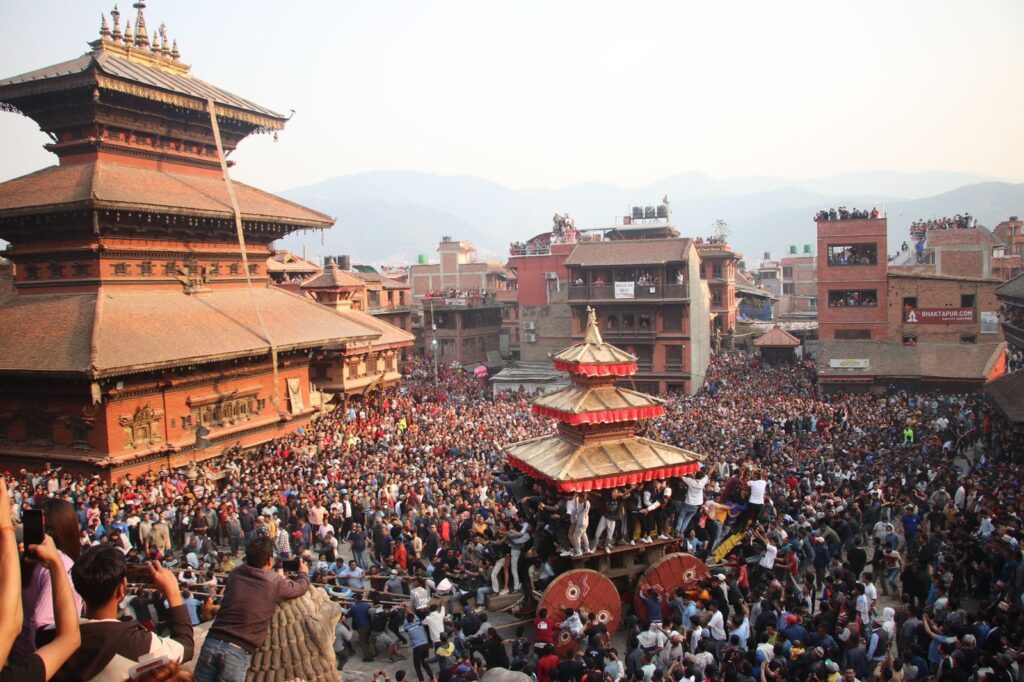
Key Takeaways
- Biska Jatra is one of the oldest continuously observed living festivals of Nepal, with a documented history spanning over five centuries.
- The festival unfolds across Bhaktapur, Madhyapur Thimi, Bode, Nagadesh, Tignani, and Tokha. Each location carries distinct rituals rooted in local myth, deity, and community structure.
- The Bhaila Kha, the chariot of Bhairab, stands among the most significant examples of living architectural craft in the Kathmandu Valley. Craftsmen assemble this chariot entirely from timber each year.
- The Guthi system sustains the festival through inherited obligations distributed across multiple communities, castes, and craft lineages. No single group controls the festival. It is the product of their collective action.
- The transmission of knowledge that keeps this festival alive faces real pressure. Documentation is necessary, but cannot substitute for living practice.
What is Biska Jatra?
Biska Jatra marks the Nepali New Year, celebrated around mid-April during the solar transition from Mina to Mesha (Pisces to Aries). It is a religious observance, a communal celebration, and a living repository of Newa art, myth, and culture. Centered at Bhaktapur, it extends across the Kathmandu Valley to Madhyapur Thimi, Bode, Nagadesh, Tignani, Dhapasi, Tokha, Dhulikhel, Katunje, Gundu, and Sanga. Each location carries distinct rituals adding a distinct voice to a shared cultural identity.
The festival spans eight nights and nine days, and remains one of the most fully realised examples of living tradition in the valley.
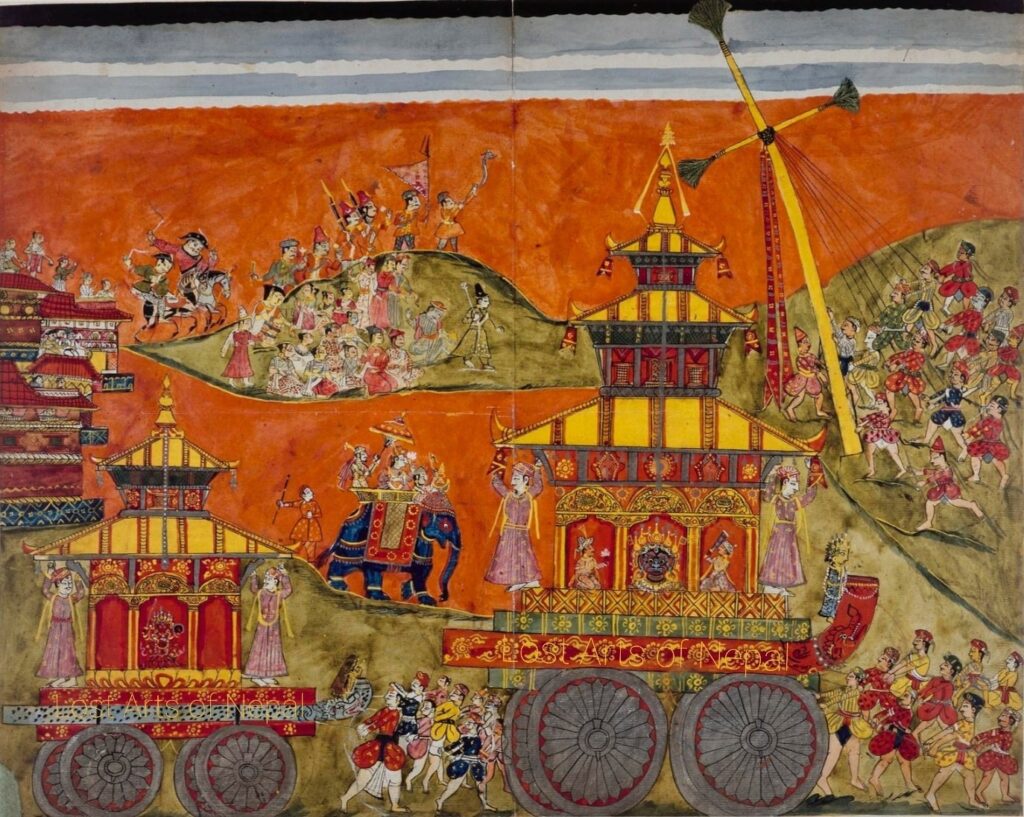
The Origins of the Name
The name carries layers of history. The most widely cited explanation traces “Biska” to two Newari words: bi meaning snake, and syako meaning slaughter, together commemorating the killing of serpents in a popular legend where a prince slays twin snakes emerging from a princess’s nostrils. However, historical and linguistic sources reveal a more complex etymology.
The name originates from the Classical Newar term biskyata, found in Malla-era records. It combines bisika, the Classical Newar term for Solar New Year, derived from the Sanskrit: visuvad meaning spring equinox, and ketu for banner. The name therefore refers to the pair of long banners raised during the Solar New Year. The serpent etymology, while widely accepted, appears to have been layered onto a more ancient cosmic observance.
Ancients Texts and Historicity
Ancient texts including the Gautami Purana reference the festival as Vishwa/ Bishwa Jatra both meaning Universal Festival, celebrated during the solar transition from Mina to Mesha. The Newari term for the ceremonial flags, halim pata, carries the same meaning: halim as world or universe and pata as flag. From this convergence, the festival has also received the name Vishwodhoj Jatra. The said banners are adorned with the pattern of Ashtamangala (Eight Auspicious Symbols).
The oldest known inscription referencing the festival survives on a stone at the Bhairab temple in Taumadhi, Bhaktapur, placed by Yaksha Malla in Nepal Sambat 561 (1441 AD). It reads: Indra Jatra konhu… Bishwa Jatra konhu, placing Biska Jatra in the same ceremonial register as Indra Jatra. This establishes a documented history of over five centuries, though actual origins reach further back into pre–Malla traditions.
The Myths Behind the Festival
Biska Jatra carries several founding myths. They differ in detail but converge on a single theme: victory. This is not incidental. The festival functions as an annual reaffirmation that danger can be overcome and that the divine stands in defence of the living. Each myth encodes this assurance in a different narrative form, and the festival’s rituals re-enact it each year.
The Princess and the Serpents
The most widely told myth centres on a cursed princess of Bhaktapur. The king had declared that whoever married his daughter would become the next monarch. Many came forward, but each groom was found dead the following morning. Eventually, despite the princess’s beauty, no one in the kingdom was willing to marry her.
Around this time, the goddess Bhadrakali, disguised as an old woman, approached a young man and urged him to accept the marriage. When he asked how he might survive the night, she revealed a sword hidden in a riverbed and instructed him to stay awake.
After marrying the princess, he kept watch as she slept. In the night, two serpents emerged from her nostrils. He drew the sword and killed them, breaking the curse.
It is believed that when he later became king, he established a festival in honour of Bhadrakali and displayed the slain serpents on a tall pole in the city square. That public display of victory became the founding act of the festival.
The Tantric Couple
A second myth is traced to the Lichchhavi period, during the reign of King Shivadev II. At the time, the Kirants are said to have invaded Bhaktapur, creating fear across the city. The king turned to Vajrayogini of Sankhu, who directed him to a tantric master, Shekhar Acharya.
Shekhar was believed to possess the ability to transform using consecrated rice husks. Taking the form of a tiger, he drove the invaders away. On his return to Thimi, he was welcomed with sindoor, an act often linked to the origin of that practice.
Later, his wife Nararupa asked to witness his transformation into a serpent. He agreed, giving her the sacred rice husks, instructing her to sprinkle them to return him to human form. But when he transformed, she panicked. As she fled, her jani loosened, and in the confusion to set her dress, she placed the rice husks in her mouth, transforming herself as well.
Unable to return to their human forms, the couple made their way toward the palace. The king, not recognizing them, drove them away. They died outside the city, and their deaths are said to have been followed by drought and misfortune.
When the king later sought out Shekhar again, he found only trails of serpents leading away from his home. Following them, he came upon the truth.
In remorse, the king ordered their cremation with royal honours at Triveni Ghat and raised a pole with paired banners in their memory. This act is believed to originate the Yosin ceremony central to Biska Jatra.
The Origin of the Chariot Procession
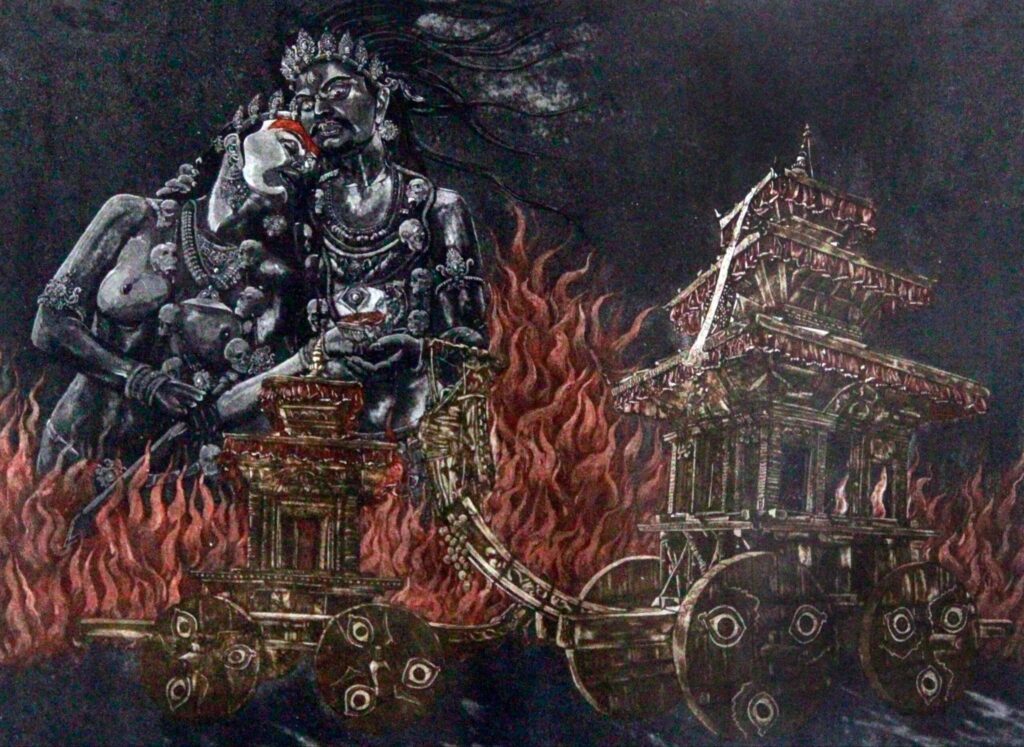
A third myth explains the origin of the festival’s central ritual: the pulling of Bhairab’s chariot. Bhairab, a wrathful form of Shiva, is said to have come to Bhaktapur in disguise, searching for his consort Bhadrakali, who had arrived from Kashi. Upon arrival, he found her already established and worshipped. Hence, he remained among the crowd and observed the festivity.
However, his presence did not go unnoticed. A tantric practitioner observed a stranger who stood taller than the rest and carried a distinct bearing. Realizing he was Bhairab, he tried to seize him, but only managed to grasp a lock of his hair, his tuppi, before Bhairab vanished.
The community saw this as a bad omen. Therefore, to appease Bhairab’s wrath, the community is believed to have begun the chariot procession in his honour. The Bhaila Kha chariot, pulled through the streets of Bhaktapur during Biska Jatra, is tied to this origin. It is also said that those who visit the chariot during the festival receive prosperity and fulfillment in the year ahead.
“These narratives reveal the role of the festivity in harmonizing the cosmic order through ritual. The poles, banners, chariots, and even the procession route draws upon tantric yantras, grounding symbolism within the physical landscape. Through this alignment, the festival is believed to ensure fertility, protection, and prosperity.
Together, they frame a worldview in which ritual action, space, and cosmology remain closely intertwined. Biska Jatra celebrates this generative interplay through rituals timed with the agricultural cycle, marking a moment of renewal as the earth prepares for cultivation.”
The Deities: Bhairab and Bhadrakali
Two deities preside over Biska Jatra. Their relationship defines the festival’s ritual structure, and their iconography carries meanings that Newa artists have rendered in wood, metal, pigment, and stone across centuries.
Bhairab and Bhadrakali are complementary forces, often associated with sky and earth, male and female principles. Their sacred union enables creation, mirroring the cycles of destruction and renewal that govern all existence. Bhadrakali is also linked to the directional geography of the Kathmandu Valley, while Bhairab, as a wrathful guardian, marks its protective boundary.
Bhairab
Bhairab, a krodha-devata, a wrathful deity, embodies the destructive aspect of divine power and functions primarily as a guardian deity in the Newa tradition.
In Bhaktapur, he is venerated as Bhairabnath. His primary image, housed in the three-tiered temple at Taumadhi Square, is a large brass mask with a pronounced wrathful expression. It is enshrined on the upper floor behind the five miniature windows, a directional orientation carrying specific protective significance in Tantric practice.
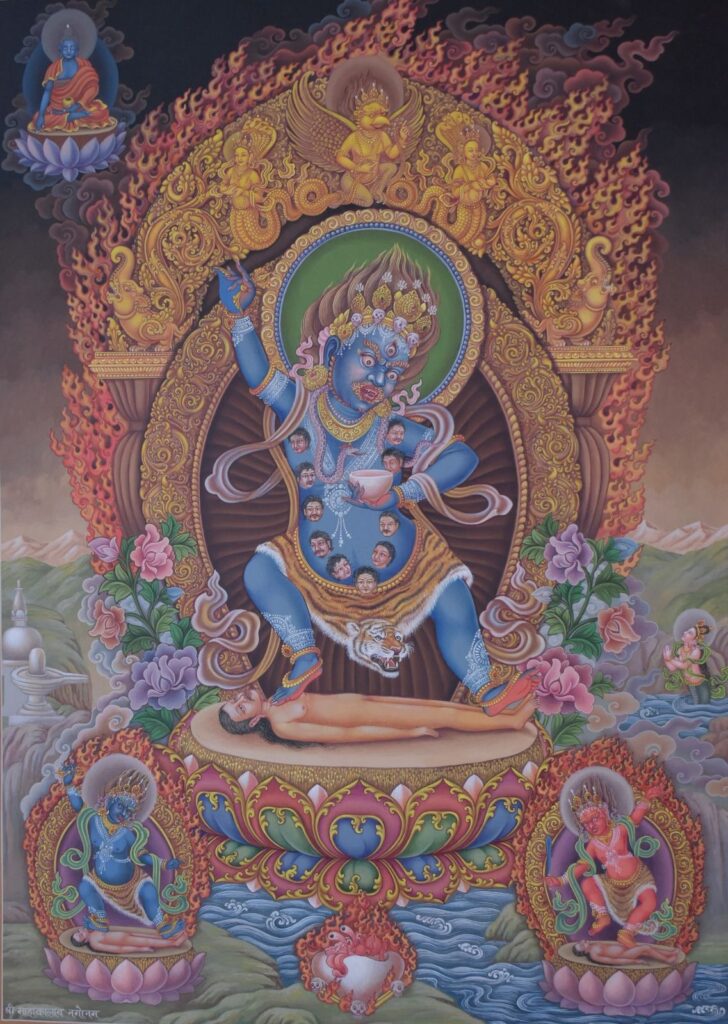
In iconographic representation, Bhairab often appears in a dynamic stance, trampling Betal, a figure associated with serpents, spirits, and disorder. This gesture signals the containment of chaotic forces. His body is rendered in dark blue or black, indicating the absolute nature of his power. He bears three eyes, with the third signifying insight beyond the visible realm, and his hair rises upward in flame-like forms.
He is frequently adorned with a garland of severed heads, each corresponding to a letter of the Sanskrit alphabet, suggesting the totality of sound and knowledge brought under control. His attributes may vary, but commonly include the trishula (trident), the damaru (hourglass drum), the khadga (sword), and the kapala (skull cup), each carrying specific meaning within Shaiva tantric practice.
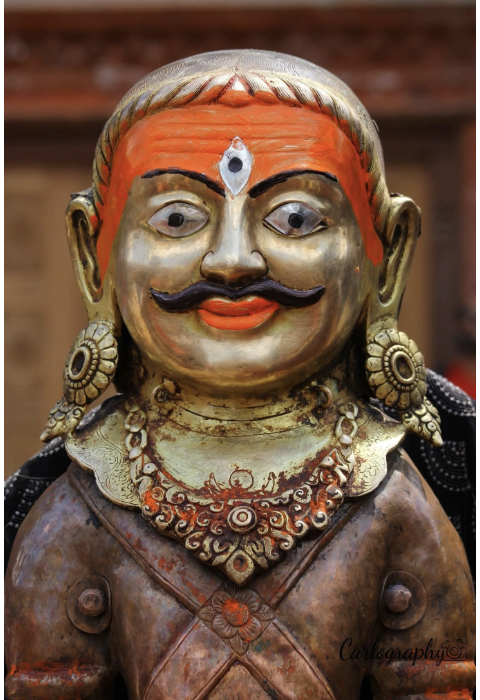
“In local belief, Betal Dyo is the maleficent king of serpents and spirits associated with blood, violence, and chaos. During Biska, the Manandhar community carries his statue, depicting him as a child, reflecting a folk tradition in which he is an incorrigible trickster suppressed by Bhairab.”
Bhadrakali
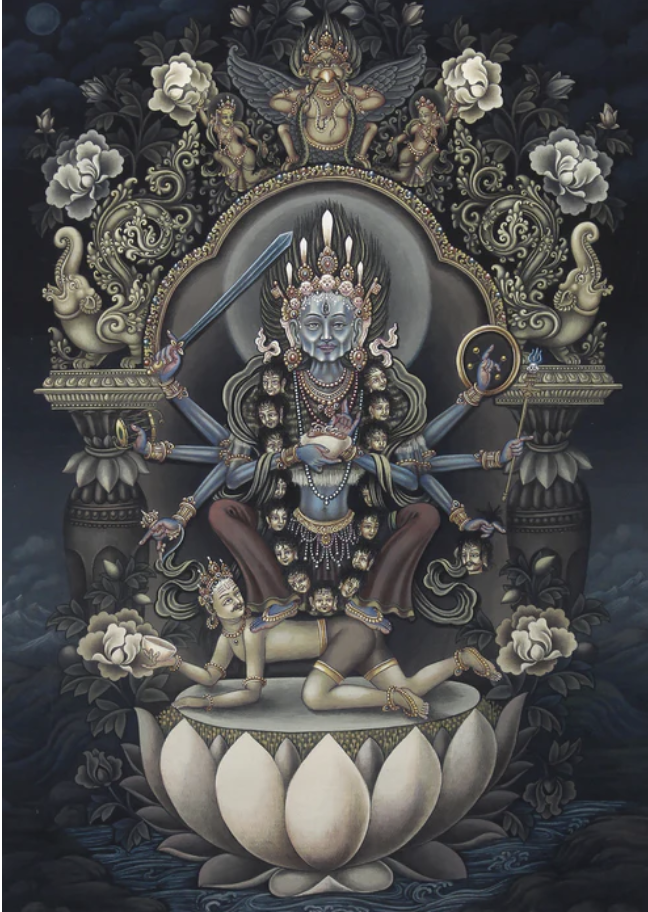
Bhadrakali is the principal consort of Bhairab and one of the most complex goddess figures in the Newa pantheon. Classified among the wrathful deities, she belongs to the broader category of Shakti, the divine feminine power that underlies the manifest world. In the Newa tradition she is known as Lunmari Ajima and is counted among the Astamatrika, the eight mother goddesses associated with the directional zones of the Kathmandu Valley.
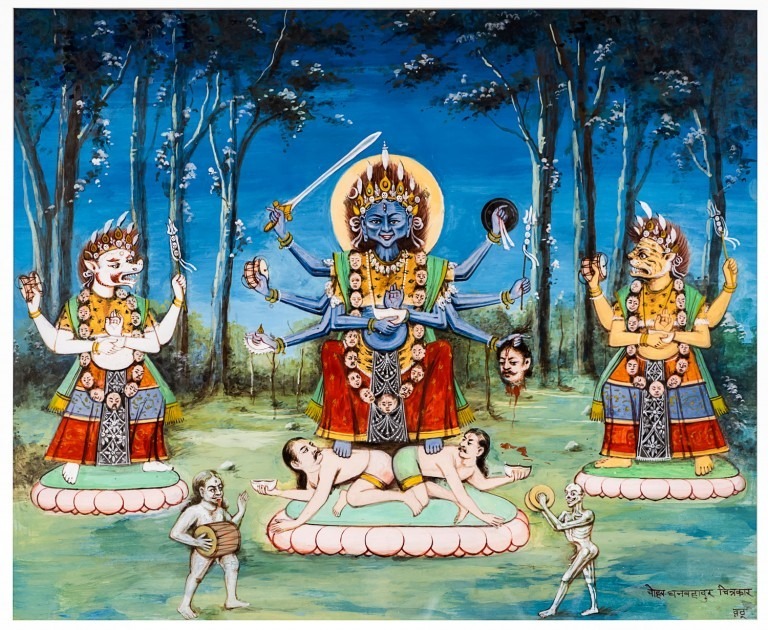
In her standard iconographic form, she is typically depicted with eight arms.Among her attributes are the khadga, the double-edged sword; the damaru; the kartika, the curved flaying knife; the kapala patro, the skull cup; the dhala (shield), the trishula (trident), and a munda (severed head), with her primary hand in bindu patra gesture.
Her stance is pratyalidha, the striding warrior stance associated with combat. Beneath her feet lie subdued figures representing vanquished adversaries. In some instances, she is accompanied by Shingni, the white lion, and Bhangini, the yellow tiger, along with demon and skeleton playing the nyakhin and chusya, traditional Newa ritual instruments. Their presence affirms that destruction and devotion are complementary expressions of the same divine reality.
In the Biska Jatra procession, Bhadrakali is carried in the Nakinchu Kha, her dedicated chariot. Her brass figurine of approximately eight inches is installed in the chariot four days before the New Year. On the night of New Year’s Eve, after the Yosin pole is felled, her chariot is drawn to Gahiti, where it meets that of Bhairab, enacting the sacred union of Bhairab and Bhadrakali.
The Chariots: Bhaila Kha and Nakinchu Kha
Biska Jatra moves on two chariots. The Bhaila Kha carries Bhairab. The Nakinchu Kha carries Bhadrakali. Distinct in scale and form, they function as a pair. Their procession, separation, and midnight convergence at Gahiti structure the festival’s ceremonial arc.
The Bhaila Kha
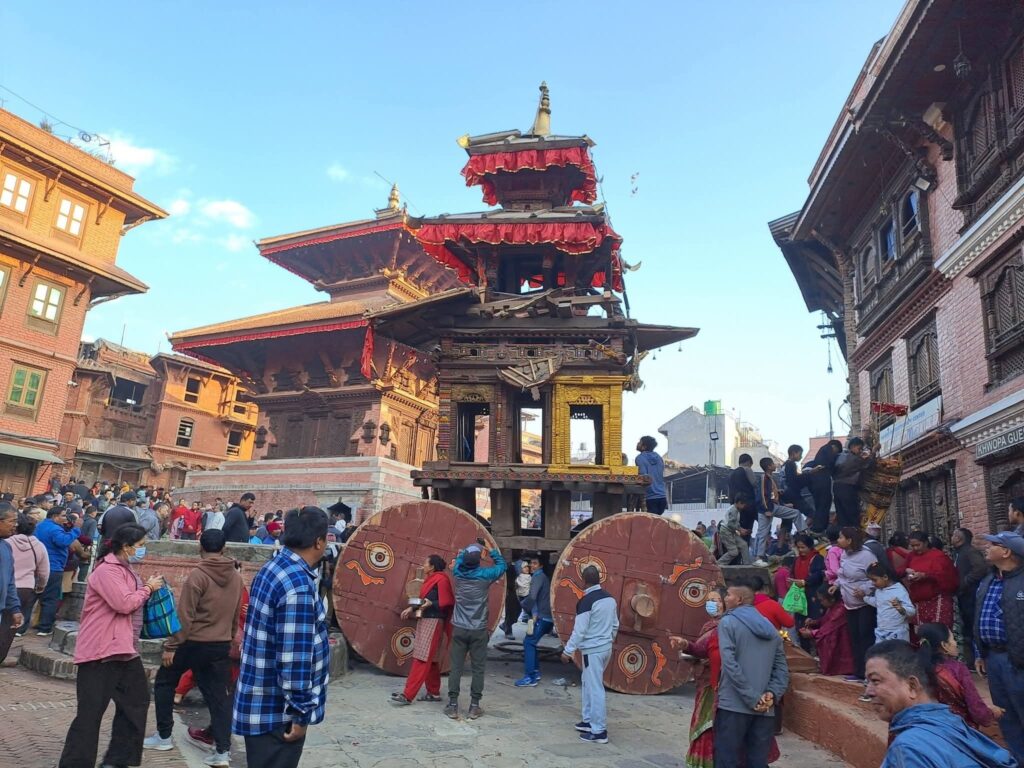
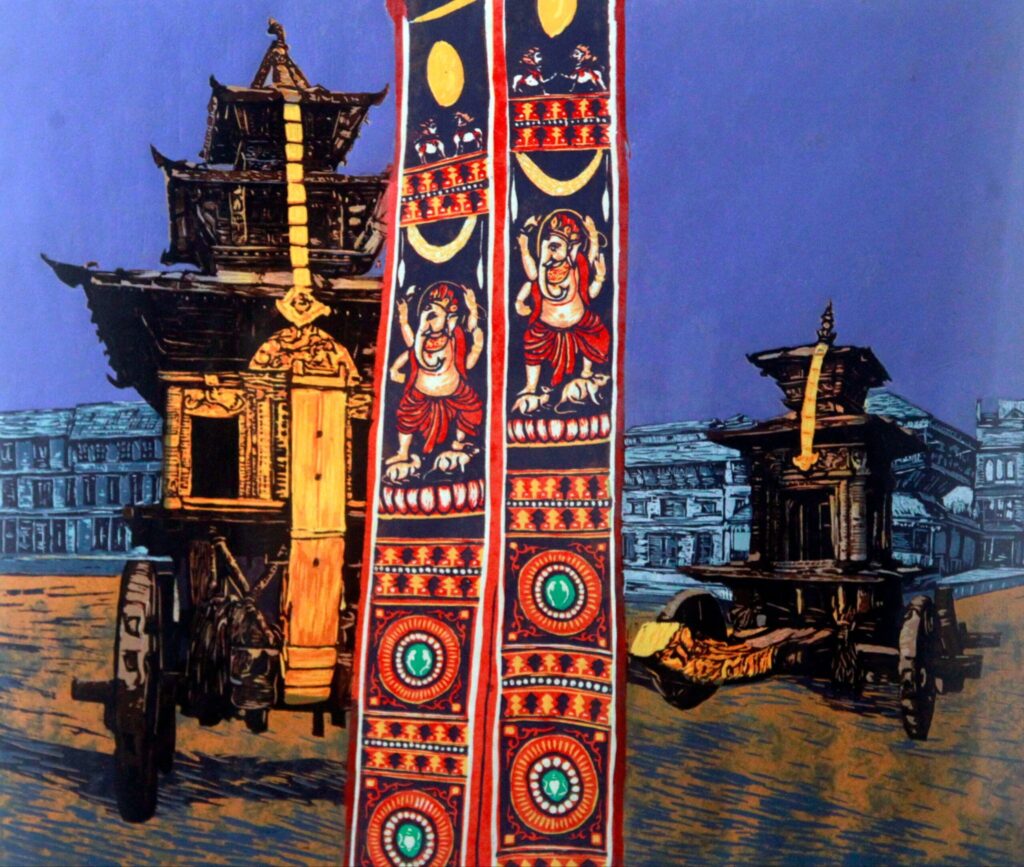
Assembled entirely from timber each year in front of the Nyatapola temple, one week before the festival begins, the Bhaila Kha stands approximately eleven metres tall and replicates the srijantra/sriyantra, a sacred Tantric symbol, in its three-tiered pagoda form. Its four solid wooden wheels measure 2.5 metres in diameter, interconnected without nails or metal hooks through traditional joinery held within Newar carpenter lineages.
The master carpenter, the kami naya, selects seven distinct types of timber for specific structural requirements and coordinates an assembly involving carpenters, metal workers, and artists working simultaneously.
“The roof structure is clad in brass. The front face of the lower storey was historically rendered in gold, however today it carries yellow pigment. The forward-curving front beam represents a serpent deity, at whose tip sits the cast metal figure of Betal, the spirit companion of Bhairab. The four wheels each carry a painted image of Bhairab’s three eyes.“
The paint system uses organic materials including boiled leather by-products combined with mineral pigments in eight prescribed colours: orange, red, maroon, black, blue, white, yellow, and green, each occupying a defined zone of the chariot’s surface.
The chariot is never structurally identical from one year to the next. It is rebuilt annually with damages replaced in-situ. After the festival, workers dismantle and store it beside the Bhairavnath temple.
The Nakinchu Kha
The Nakinchu Kha is smaller in scale, assembled near the Bhairavi temple. Priests install Bhadrakali’s brass figurine of approximately eight inches four days before the New Year. The Nakinchu Kha has received considerably less systematic documentation than the Bhaila Kha. Its construction materials, joinery system, and pigment programme remain unrecorded in comparable detail, a gap that warrants dedicated research.
The Festivals Unfold: Day by Day
Use this timeline to plan your visit to Bhaktapur and the broader Kathmandu Valley during Biska Jatra. Dates follow the Bikram Sambat calendar, with Gregorian dates falling in mid-April.
Chaitra 28: Opening Day
In Bhaktapur, priests install the brass figurines of Bhairab and Bhadrakali in their chariots at Taumadhi Square. The Bhaila Kha is assembled one week before the ceremony begins, in front of the Nyatapola temple. An appointed government official presents a sword at Taleju temple, assuming the ceremonial role of the Malla king.
In Tokha, the chariots of Chandeshwori and Mushkhareshwor Shiva are brought into the temple complex, while six additional chariots move from Thalag Tole. Guthi members remain in vigil through the night, accompanied by aarti, Newari songs, and traditional instruments.
Chaitra 29: The Chariot Procession and the Tug of War
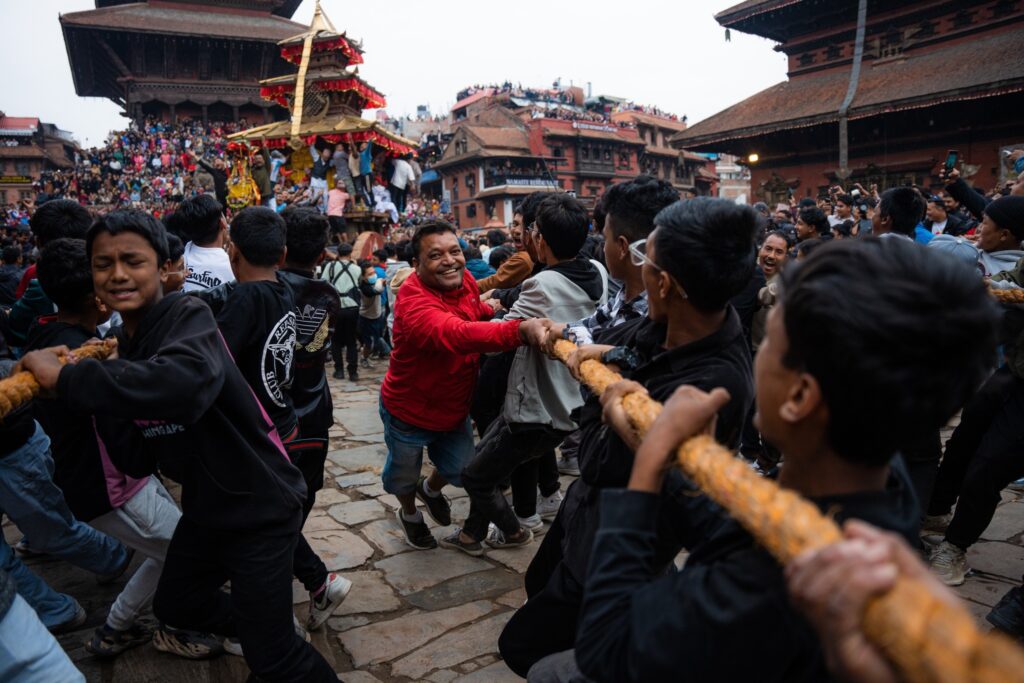
The procession opens with the ritual known in Newari as dya koha bijyaigu,the bringing out of the deity from the temple. In the open square, two groups known as Thane and Kone take hold of the ropes in a direct contest of strength. The winning direction determines where the chariot moves and claims the omen of good fortune for the year.
If the eastern Thane party wins, the chariot moves towards Golmadhi. If the western Kone group wins, it moves towards Naasamanaa, or occasionally Tekhapukhu.
Throughout the procession, Newari musical ensembles accompany the movement, forming a continuous ceremonial soundscape. The event draws large crowds, offerings of rice, flowers, coins, oil lamps, and vermilion, and includes masked dances performed alongside ongoing music. Police presence is significant, as injuries are not uncommon during the rope pulling.
In Tokha, eight chariots proceed under the lead of Ganesh Kumar, completing one full circuit before the others begin their movement. The procession continues late into the night, accompanied by Dawakhalag musical groups.
Chaitra 30: The Yosin Pole
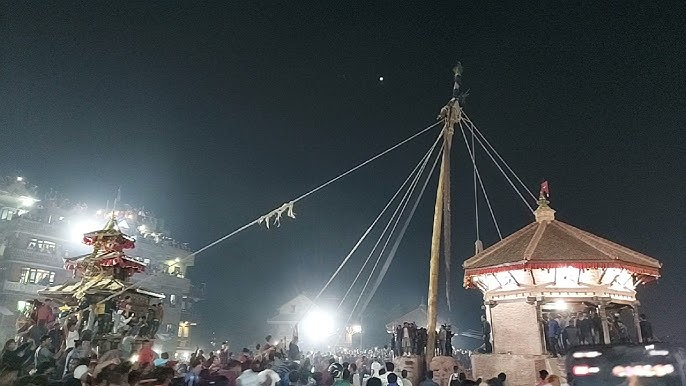
On this day, two lingos mark the end of the old year. An armless Lyo Sin Dyo is raised at Pottery Square at midday, followed by a second lingo with arms at Khalna Tole in the evening. Chariot groups then converge at Yosinkhel, where the twenty-five-metre Yoh si Dyo is raised. It is supported by eight ropes representing the Astamatrika. Two flags are unfurled from a crossbeam near the top.
The success of the raising, along with the orientation of the pole, is read by communities as an omen for rainfall in the agricultural year ahead.
On the same evening, the Tipwa Jatra begins. The Barahi Khat palanquin is carried from Barahi Dya Chhen in Bansa Gopal to Barahi Ajima in Suryabinayak, crossing a river along the route. It is circumambulated at the shrine and remains there overnight.
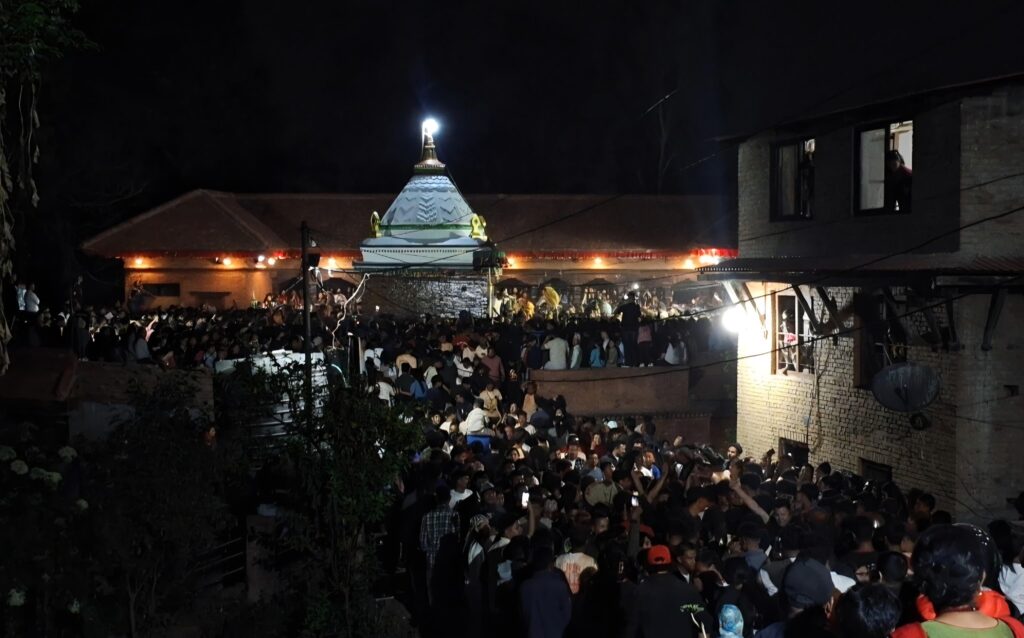
In Thimi the Jatra officially begins with the Vishnuvir (Sunga Dya) procession, the ritual of Mikhu Me at Balkumari. After this, musical ensembles arrive at the Pulangu Dya Chhen (deity house) of Sunga Dya to bring Brahmayani, Vaishnavi, and Maheshwari to the main temple.
In Bode, the tongue-piercing volunteer begins a four-day purification process that includes shaving the head, eyebrows, and beard, along with periods of solitude and a restricted diet without meat, garlic, or salt.
In Tokha, five chariots are immersed in the pond at Bhutkhel as an act of purification. On their return, the chariots of Masankali and Kore Ganesh block the settlement gate, a brief ritual interruption that is resolved before the deities re-enter the community.
Baisakh 1: New Year’s Day

Two teams pull the Yosin until it falls. The New Year begins at the moment the pole strikes the ground. The old year ends and the serpent demons are slain once more.
The Bhaila Kha is then brought back to Gahiti from the Bhairab temple. At the same time, the Nakinchu Kha is brought from the Kone region to Gahiti. The two chariots are gently struck against each other three times and worshipped by the Pujaris before the Nakinchu Kha is separated. Both chariots then converge at Gahiti at midnight, enacting the ritual union of Bhairab and Bhadrakali.
In the days that follow, Astamatrika processions carry Brahmayani, Ganesh, Mahakali, and Mahalaxmi through the streets.
Across the valley, the first day of Baisakh opens the khat festival. In Thimi, the Balkumari Kwaha Bijyakigu procession carries Balkumari’s image to the temple at Kwalakhu, formally opening the Sindoor Jatra. In Nagadesh, the Siddhi Ganesh khat begins its evening procession from Lachhi Tole.In Bode, during the Bahunisiya Jatra, the Kalika deity is carried to Kalika Temple at Tankwa, left overnight, and quietly transferred to Pachho Tole before dawn. In Tignani, the Nilbarahi procession moves from Tadham Tole to Saraswati Khel. Nilbarahi is one of the four Barahis of the Kathmandu Valley and holds a specific protective role within the ritual geography of Madhyapur Thimi.
In Tokha, the fourth day concludes the festival with a final chariot procession within a white-cloth bounded circular route. All chariots return to Thalag Tole. The Guthi distributes samaybaji to chariot carriers and musicians, and the festival comes to a close.
Baisakh 2: The Sindoor Jatra and the Tongue Piercing
On the seventh day, the two palanquins of Mahalaxmi and Mahakali are joined at Bhola Chhen, where priests conduct a puja ceremony. This convergence of the two goddesses carries its own ritual significance.
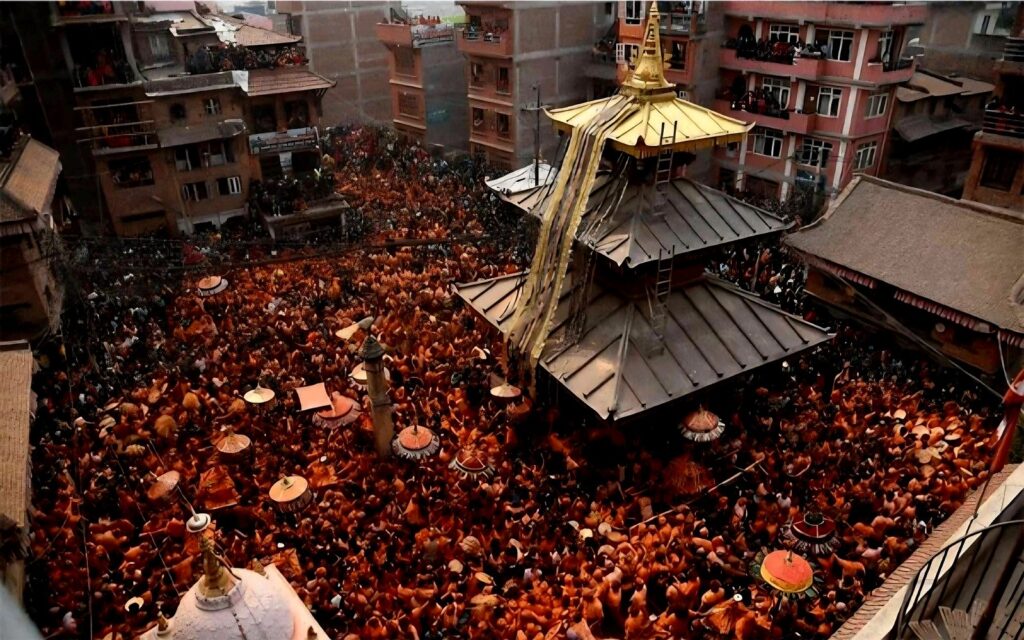
In Thimi, thirty-two khats are traditionally associated with the festival, though in the present day only nineteen are brought out. These ornate canopied palanquins carried on bamboo poles, bring deities from Thimi, Nagadesh, Bode, and Tignani. Participants drench one another in orange vermilion powder, an act of respect and blessing extended to both humans and deities. The festival’s alternative name, Sweenikha Jatra, reflects this collective convergence. The arrival of the Ganesh khat from Nagadesh, accompanied by hundreds of vermilion-covered torch carriers, marks the climax. Other khats attempt to block its return, before all eventually disperse.
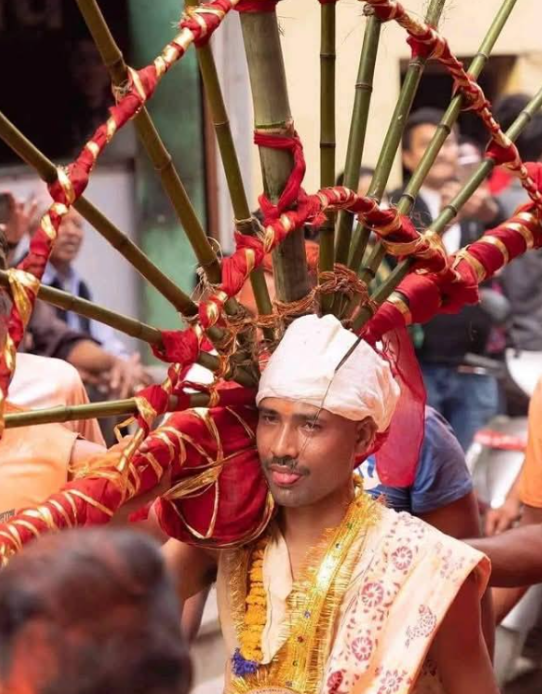
In Bode, the tongue-piercing ceremony takes place at midday at the Pancho Ganesh platform. The karmi naike receives an oil-soaked iron needle from the nakarmi. The naike pradhan first worships it with flowers, coins, and rice, before the karmi naike drives it through the volunteer’s extended tongue.
The volunteer then carries the Mahadip, a bamboo torch structure, through the lanes of Bode. The needle is removed at Mahalaxmi Temple, and temple-floor soil is applied to the wound. The absence of bleeding is taken as confirmation of a successful ritual performance. The wound is said to heal quickly, with no lasting damage, an outcome understood within the community as part of the ritual’s sanctity.
The khat procession begins only after this ceremony concludes. Seven khats, led by Pacho Ganesh, move through the toles and conclude with the laskus, the ceremonial return of Kalika to her shrine.
In Tignani, the Nilbarahi procession moves to Sanuchwa to receive arriving deities from Nagadesh and Bode. Historically, this inter-settlement convergence was more extensive, with deities moving across all four settlements in a dense choreography of mutual recognition. That circulation has diminished in recent years, a contraction noted by both practitioners and researchers.
Baisakh 5: The Return
The Bhaila Kha is pulled from Gahiti to Taumadhi for the last time in a ritual known as dya thaha bijyaigu, meaning the return of Bhairab to the temple. As on the first day, both Thane and Kone teams pull the chariot from opposite sides before it is finally settled within the premises of Nyatapola Temple. The deities return to their shrines, and the city returns to ordinary time until Chaitra comes again.
Baisakh 8: The Sagun Ceremony
On the eighth day, the Dya Swogan Be Garne, or Sagun Ceremony, is performed. Priests offer five ritual delicacies to the deities: rice wine, meat, fish, boiled egg, and lentil cake. Each corresponds to one of the five tantric elements: fire (rice wine), earth (meat), water (fish), air (boiled egg), and ether (lentil cake). This elemental correspondence encodes a Tantric cosmology within what appears on the surface to be a feast.
The Chariot as Community: Guthi, Lineage, and Collective Identity
Biska Jatra is produced by a network of communities bound through inherited obligation. The Guthi, a hereditary collective body, passes ritual responsibilities from father to son along with the knowledge, tools, and relationships each role requires. No single group controls the festival. Its structure depends on the interdependence of these collectives, where responsibility is distributed across lineages rather than centralized. This division is not only organisational but social, reflecting a model of community in which no group is complete on its own.
Occupational Lineages
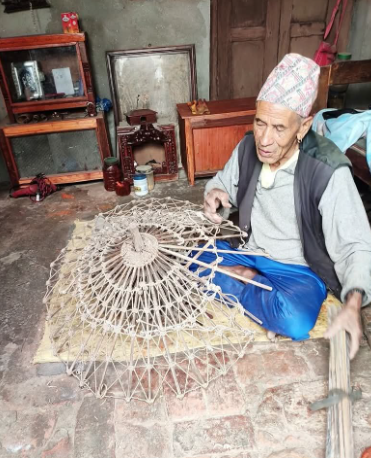
The Bhaila Kha draws on occupational lineages whose specialisations have been maintained across generations. The kami naya oversees the structural system of the chariot, including timber selection, joinery, and overall proportion. Metalworker families produce and maintain fittings, reinforcements, and ritual elements such as the Betal figure. Similarly, Pu, painter families prepare the deities, chariot surfaces, masks, and ritual imagery using inherited pigment systems. Separate lineages produce the chhatra, the large ceremonial parasols that accompany the deities.
Each group contributes a distinct layer of knowledge that others do not hold. The whole festival only exists through this convergence.
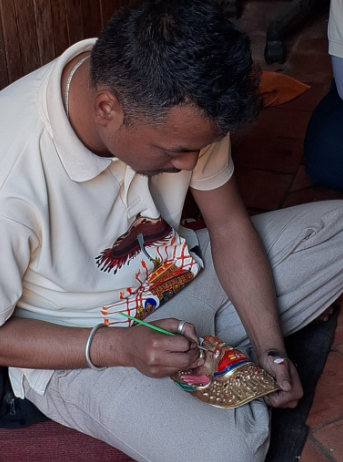
Artist Sundar Shrestha painting ritual masks at Layaku Durbar Square.
Mangal Lal Shrestha making ceremonial Chattra (umbrella) for Biska Jatra.
Sacred Routes and Collective Identity
Across the Kathmandu Valley, every deity procession moves along fixed routes. These are not chosen or improvised, but inherited. Each route traces a path through the sacred geography of its settlement, connecting temples, thresholds, toles, and gates. Communities know which threshold requires which offering, and which gate a deity must pass before another may move. This knowledge is not written. It is transmitted through participation.
In Bhaktapur, the Bhaila Kha follows a set route through the city, maintained and cleared by the community each year. In Thimi, thirty-two khats move along prescribed paths from their respective settlements before converging in sequence at Balkumari. The festival does not dissolve these distinctions. It brings them into coordination.
In Tokha, the chariot of Ganesh Kumar completes its full circuit before any other chariot begins its movement, maintaining an established order of procession.
What holds these movements together is collective knowledge that gets renewed annually.
Living Heritage Under Pressure
Biska Jatra continues to be observed with vitality across the Kathmandu Valley. Yet the conditions that sustained it for centuries are shifting, and the pressures are specific enough to name directly.
Transmission
The knowledge required to build the Bhaila Kha, perform installation rites, and execute ritual sequences is not contained in any archive. It is distributed across lineages of practice and transmitted through years of participation. The kami naya who leads the assembly has noted that younger members of these lineages show limited interest in continuing the practice.
When a lineage loses its last practitioner before transmission is complete, that knowledge does not become inaccessible. It ceases to exist.
A similar shift is visible in Thimi, where the khat system has already contracted. While thirty-two khats are traditionally associated with the festival, only nineteen are now brought out. This reduction reflects not only logistical change but also the thinning of participating lineages responsible for maintaining specific deities, routes, and ritual roles.
Urbanisation and Spatial Pressure
Bhaktapur is a UNESCO World Heritage Site, yet urbanisation, developmental constructions, and shrinking of public spaces, create pressure on the ritual routes and spaces that structure Biska Jatra. The challenge is not with the width of roadways or size of open space, but with the integrity that have historically connected temples, toles, and open grounds in specific sequences. In some areas, routes are interrupted or altered by construction, bridges, and changing street use, while temporary stalls can obstruct movement during peak festival periods.
These are not abstract concerns but practical conditions that determine whether ritual sequences can continue in their full form.
The festival depends on the city’s ability to continually accommodate these conditions.
Documentation and Its Limits
Researchers have documented the Bhaila Kha through hand surveys, measured drawings, photography, and videography. Academic studies have also examined its mythology, semiology, and ritual structure. This work creates records where none previously existed. However, it cannot capture the carpenter’s judgment in selecting timber, reading grain before cutting a joint, or assessing structural integrity under time pressure. Documentation preserves evidence of tradition, but only practice preserves the tradition itself. The two are necessary, but not equivalent.
The Role of Institutions
The Guthi system has historically provided the festival’s institutional support from within the community. As participation declines and obligations become harder to fulfil, external institutional engagement becomes more important. The role of museums, heritage organisations, and cultural institutions is not to manage or direct living traditions. It is to document, support, and advocate, and to ensure that the knowledge carried within these traditions is recognised as the irreplaceable asset it is, and that those who carry it receive the recognition and resources their work deserves.
Biska Jatra and the Future of Living Heritage
Biska Jatra is not a relic. It is a living system in which theology, craft, social organisation, and community identity remain interdependent. It has continued in this form for centuries. Its continuation is not in question. What matters are the conditions that make it possible.
Those conditions are specific: the transmission of traditional knowledge within lineages of practice, the maintenance of Guthi obligations and the social relationships they sustain, the preservation of the spatial routes and open grounds through which the festival unfolds, and the continued engagement of researchers and institutions that recognise what is at stake when living systems contract.
No museum collection can replicate what Biska Jatra holds. Each year the chariot is rebuilt, the deities are carried through the streets, families receive them into their homes, and communities follow established routes of movement, offering and participation. These actions are not symbolic alone; they are the structure of the festival itself.
Documentation can preserve records but it cannot replace transmission through practice. What is recorded can be studied but what is not transmitted is lost. Preserving living heritage is not about freezing it in time, but about sustaining the conditions that allow knowledge to pass from one generation to the next.
Biska Jatra continues because communities continue to carry it. Its future depends on whether these responsibilities remain meaningful within changing social and economic conditions, and whether the systems that sustain them can continue to adapt without losing their core knowledge and value.
The Himalayan Art Council documents, authenticates, and advocates for the living art and cultural traditions of the Himalayan region. If you are working in heritage preservation, research, or community documentation, we welcome your engagement.
Frequently Asked Questions
What does the name Biska Jatra mean?
The most widely cited explanation derives “Biska” from two Newari words: bi (snake) and syako (slaughter), referencing the killing of serpents in the festival’s founding myth. Historical sources suggest the festival may originally have been called Vishwa Jatra, a cosmic new year celebration marking the solar transition from Mina to Mesha. The serpent etymology, while widely accepted, appears to have been layered onto a more ancient observance.
How long has Biska Jatra been celebrated?
The oldest known inscription referencing the festival dates to Nepal Sambat 561, during the reign of Yaksha Malla, giving Biska Jatra a documented history of over five centuries. References in the Gautami Purana and the etymology of halim pata point to an older layer of cosmic new year observance that predates this inscription.
Where is Biska Jatra celebrated?
Biska Jatra is celebrated primarily in Bhaktapur, which hosts the festival’s principal ceremonies. It also extends to Madhyapur Thimi, Bode, Nagadesh, Tignani, and Tokha, each observing its own distinct ritual calendar while sharing the festival’s foundational structure.
What is the Guthi system and why does it matter for Biska Jatra?
The Guthi is a hereditary collective body whose members share defined obligations toward a deity, temple, or festival. Biska Jatra is sustained by multiple Guthis operating in parallel, each holding a specific function. The festival cannot occur without this distributed network of inherited responsibilities. As Guthi participation declines under modernisation and urbanisation, the festival’s long-term continuity faces real institutional risk.
What is the significance of the tongue-piercing ceremony in Bode?
Observed in Bode on the second day of Baisakh, this ritual involves a male volunteer who undergoes four days of purification before the karmi naike drives a long oil-soaked iron needle through his extended tongue. The volunteer then walks the lanes of Bode carrying the burning Mahadip torch structure. The needle is removed at the Mahalaxmi temple and the absence of blood confirms the act’s spiritual integrity. The ritual preserves the memory of a malevolent spirit captured and punished in Bode’s founding mythology.