
A Personal Note by Meena Lama
Curating Tracing the Himalaya has been one of the most meaningful experiences of my practice, not only because of the art on the walls, but because of the relationships, stories, and communities that came together to make this exhibition possible. Each of the four participating artists comes from a homeland I have come to understand more closely over the years, and each carries the generational knowledge, craftsmanship, and memory of the Himalaya.
This exhibition began as an artist-led initiative, and my curatorial role grew from a place of trust and long-standing collaboration. The exhibition brought together Mustang, Dolpa, Sindhupalchok, and Mugu, not as geographical labels, but as lived worlds expressed through pigment, line, texture, and tradition.
An Opening Unlike Any Other
The opening of Tracing the Himalaya was unlike most exhibition inaugurations in Kathmandu. Before a single speech was given, the exhibition space filled with voices, drums, and dances from the artists’ own communities.
Cultural groups from Dolpa, Mugu, Sindhupalchok, and Mustang opened the exhibition with traditional welcome songs and regional dances, turning the gallery into a living cultural space rather than a formal program.
For a moment, the Nepal Academy of Fine Arts (NAFA) felt as if it had shifted closer to the mountains, carried by songs sung in the artists’ mother tongues, the sounds of home echoing through the halls. It was a powerful reminder that Himalayan art is not separate from Himalayan life; it is sustained by community, ritual, and the people who continue to embody these traditions.
We were deeply honored to have the Chancellor of NAFA, Naradmani Hartamchhali, inaugurate the exhibition. And I remain sincerely grateful for the presence of His Eminence Shyalpa Tenzin Rinpoche, His Eminence Ranag Rinchen Rinpoche, Dakshyana Pradhan, U.S. Embassy (Public Affairs Section), Prabha Amatya from GATE College and representatives and dignitaries from Mugu, Dolpa, Mustang, and Sindhupalchok.
Their presence affirmed the importance of this initiative and the value of artistic voices emerging from Nepal’s high highlands.
Curatorial Perspective: Tracing Worlds Within a Nation
Among the exhibitions currently unfolding in Kathmandu, Tracing the Himalaya stands out as a significant moment, a rare meeting point where institutional support from NAFA is aligned with a grassroots vision shaped entirely by the artists themselves.
Nepal’s artistic heritage extends well beyond its urban centers. This exhibition focuses on the highlands, where spiritual traditions, ecological realities, and cultural practices converge to create a visual language defined by altitude, devotion, and resilience. Through thangka art and contemporary landscape works, these four artists explore not only the geography of the region but also the deep sense of belonging to their communities, the mountains, and the spiritual traditions that have guided generations.
Artist-led initiatives like this carry a sense of honesty, urgency, and authenticity that cannot be replicated by institutions alone. As a curator, it is my honor to support this collective vision by providing a curatorial framework and technical assistance, which facilitates a meaningful dialogue between these artists and broader audiences.
The Artists: Four Journeys, One Landscape of Memory
Tsering Phonjo Gurung, Mustang
I first met Tsering during my years at the Taragaon Museum, and over time, we have collaborated on numerous projects, including KALPA: The Timeless Heritage of Himalayan Art, Mustang Fiesta, and many community initiatives. Tsering is one of the most sincere artists I know, someone who carries Mustang in his heart wherever he goes.
Whether he is painting thangka, large-scale decorative walls, or fine art compositions, his works are always rooted in home, in the cliffs, chortens, monasteries, and memories of Mustang. He often uses natural pigments made in Mustang, which gives his paintings a raw, grounded authenticity that few contemporary artists practice today. Working with him again for this exhibition felt like reconnecting with an old rhythm.
Pemba Sherpa, Sindhupalchok
Introduced to me by Tsering, Pemba is an exceptional thangka and mural artist. His dedication and humility impressed me a lot. He has spent nearly two decades painting monasteries across Asia. He specializes in wall-sized thangka, monastery murals, and even cement sculptural ornaments for Buddhist architecture.
For this exhibition, he brought remarkably large mandala paintings, the kind traditionally placed on ceilings or temple walls, a rare sight in a gallery setting. One of his works exhibited previously at Patan Museum had even received HAC’s Certificate of Authenticity with NFC and hologram verification. Getting to work with his meditative compositions in this exhibition reminded me how deeply Himalayan art is connected to devotion and practice.
Dorjee Gurung Lama, Karmarong, Mugu
Before I met Dorjee, I encountered his work at Siddhartha Art Gallery in 2024. His paintings of Karmarong stayed with me long after the visit. Later, we worked together for the recent Traditional Thangka & Paubha exhibition at Patan Museum, and I came to know the depth of his artistic spirit.
Dorjee is not just an artist; he is a singer and writer, weaving the soul of Karmarong into every medium he touches. His landscapes in this exhibition are extraordinary. They reveal the environment, culture, and daily life of Karmarong with tenderness and truth. In his works, traditional color style is used for rural storytelling that honors resilience, heritage, and the intimate relationship between people and land. He paints a place still unknown to many, yet incredibly alive in his vision.
Tenjen Angdak Gurung, Dolpa
I had the opportunity to work with Tenjen Angdak Gurung earlier this year during the Patan Museum exhibition. Born in Dolpa, he trained as a thangka artist at Yungdrung Kundrak Ling Bon Monastery and has dedicated more than 27 years to the practice of traditional Buddhist thangka.
What makes his contribution to Tracing the Himalaya especially meaningful is his focus on the Bon tradition, a lineage rarely presented in Nepali galleries. Bon artworks are seldom exhibited publicly, and having them represented here carries both cultural and historical significance. Tenjen’s deep knowledge, discipline, and technical mastery bring this tradition to life with clarity and sincerity, offering viewers a rare glimpse into a spiritual heritage that is often overlooked.
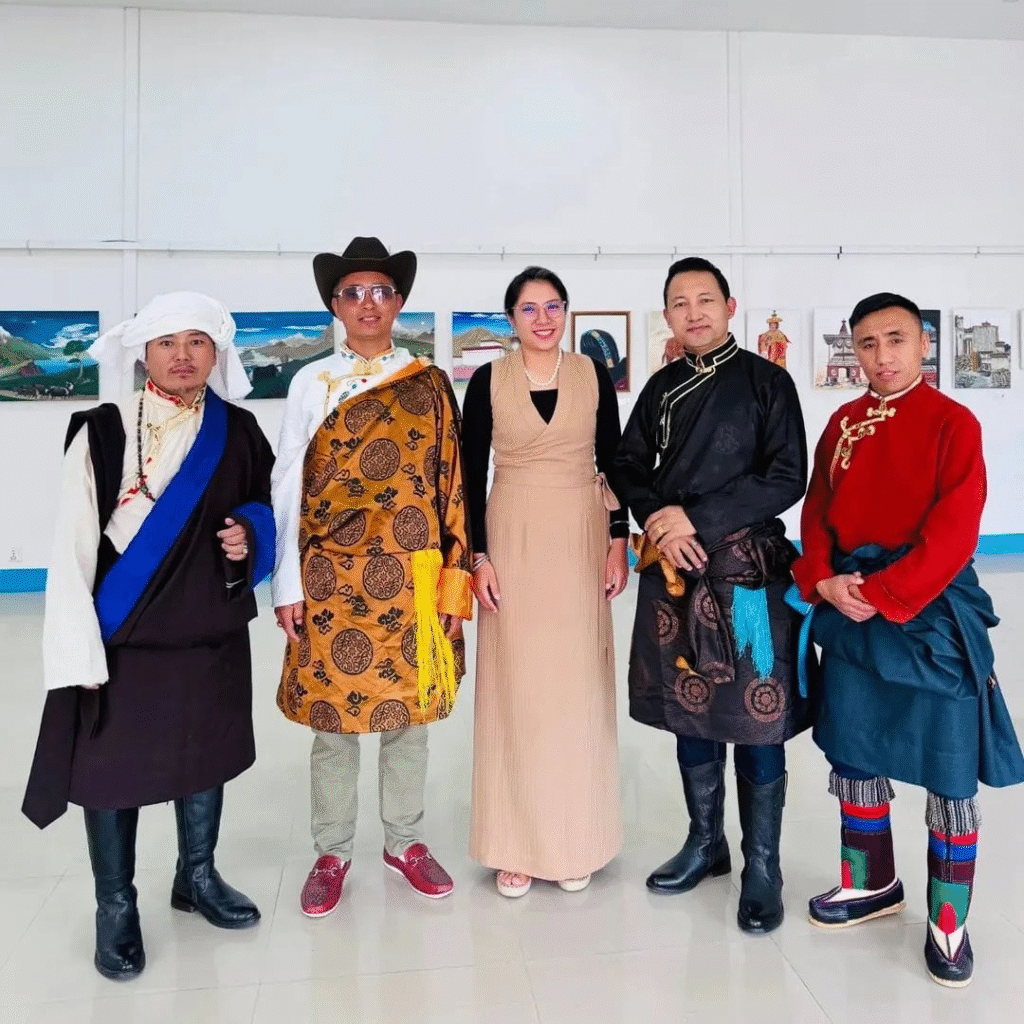
Behind the Scenes
Beyond coordinating with NAFA and the artists, I worked closely with the HAC technical team to prepare artist profiles in their certification system, which will be made public soon. Documenting these artists and their journeys felt essential not only to support this exhibition but to ensure that their stories, lineages, and practices are recorded with accuracy and care. This process is meaningful as it safeguards their legacies for wider audiences and contributes to the long-term preservation of their histories.
Closing Reflection
Tracing the Himalaya is more than an exhibition. It’s a convergence of relationships, regional identities, and artistic visions. These four artists trace not just geographic terrain but lived experience. They show us Mugu, Dolpa, Sindhupalchok, and Mustang through eyes that know these places intimately.
A heartfelt congratulations to the four exhibiting artists: Dorjee Gurung Lama, Pemba Sherpa, Tenjen Angdak Gurung, and Tsering Phonjo Gurung for leading this meaningful initiative and representing their communities with such integrity.
Curating this exhibition has truly been an honor. It reminded me that the Himalaya is not a distant frontier; it is carried within the artists who continue to create, preserve, and share its stories.