
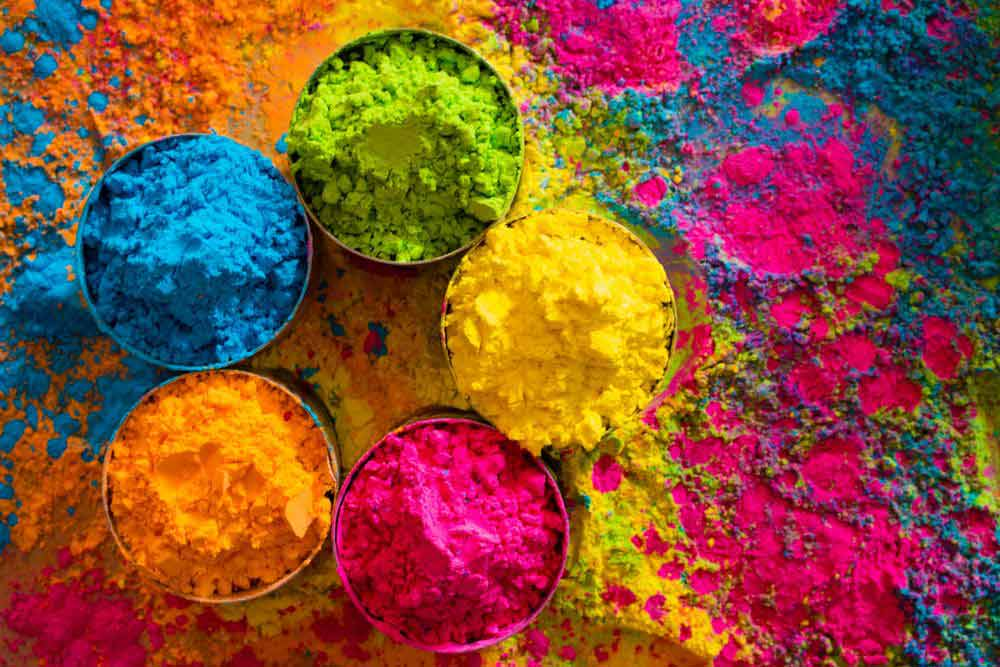
Fagu Purnima, widely known as Holi in Nepal, is a spring festival observed across Nepal and India. Celebrated on the full moon of Falgun in the Hindu lunisolar calendar, it marks the transition from winter to spring. Beyond its popular identity as the Festival of Colors, Holi integrates cosmology, devotion, ecology, and collective memory.
In Nepal, the festival is observed on the full moon day in the hills, including the Kathmandu Valley, while the Terai celebrates the following day. This variation reflects both calendrical rhythm and regional tradition.
Scriptural Foundations
Holi is referenced in classical texts including the Jaimini Sutras, Grihya Sutras, Bhavishya Purana and Narada Purana. The festival’s central ritual narrative is Holika Dahan, which recounts the story of Prahlad and his devotion to Vishnu.
According to tradition, the asura king Hiranyakashipu sought to assert absolute authority and demanded that all worship him. His son Prahlad refused and remained devoted to Vishnu. In an attempt to eliminate him, Hiranyakashipu sought the help of his sister Holika, who possessed a boon from Brahma granting protection from fire. She sat on a pyre holding Prahlad on her lap, expecting the boon to protect her. However, through divine intervention and the power of devotion, Prahlad survived while Holika was burned.
Vaishnava traditions also associate the festival with Krishna Lila in Gokul and Vrindavan. Accounts of Krishna’s playful interaction with the gopis, including the use of color, shape the aesthetic and devotional dimensions of Holi. In Nepal, it is also associated with the triumph of good over evil found in the Ramayana tradition.
Together, these narratives frame Holi as a ritual of protection, renewal, and seasonal transition.
Ritual Observance and Celebration
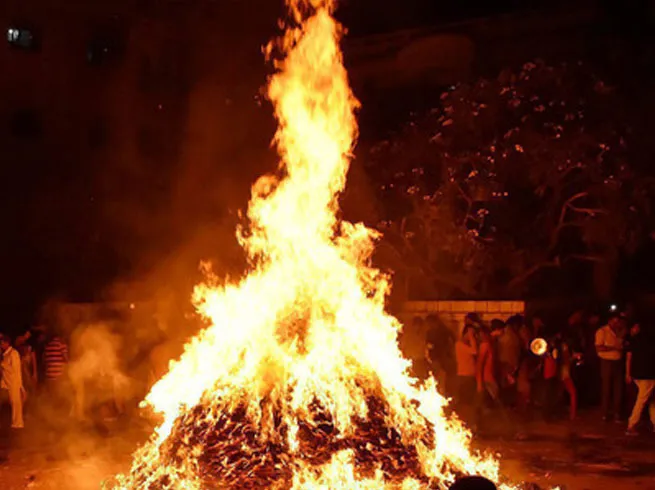
The ritual foundation of Holi is Holika Dahan, observed on the evening before or on the full moon, depending on regional practice. The ritual bonfire symbolizes the protection of devotion and the defeat of destructive intent. In Kathmandu, the burning of the Chir (lingo/pole) is locally understood as a form of Holika Dahan.
Holi or Fagu Purnima as the name suggests, falls on the final day of Shukla Paksha, the waxing lunar fortnight, when the moon reaches fullness, typically in late February or March. In South Asian cosmology, the full moon symbolizes completion, clarity, and heightened spiritual energy. Many households observe fasting and worship Vishnu, including Satya Narayan Puja, concluding rituals after moonrise. This ritual dimension coexists with public celebration.
Public Celebration in Nepal
In Nepal, Holi is observed over two days, with regional variation. In the hill regions, including Kathmandu and Pokhara, it is celebrated on the full moon day. In contrast, the Terai region observes the festival the following day. This timing aligns with the conclusion of the Mithila Madhyamik Parikrama, a fifteen-day pilgrimage through the Mithila region of Nepal and adjoining areas of India associated with the sacred geography of Janakpur and the tradition of Sita.
The circumambulation begins on the no moon of Amavasya of Falgun and concludes on Purnima (full moon). Pilgrims complete the Antargriha Parikrama in Janakpur on Purnima, and Holi is celebrated in the Terai the following day.
On the day of Holi, communities gather in streets, courtyards, and public spaces. Participants apply colorful pigments (abir) to the face and forehead. Colored water is sprayed using pichkaris. Music and singing accompany the gatherings. Water balloons, locally called lola, were once common but are increasingly discouraged due to safety concerns.
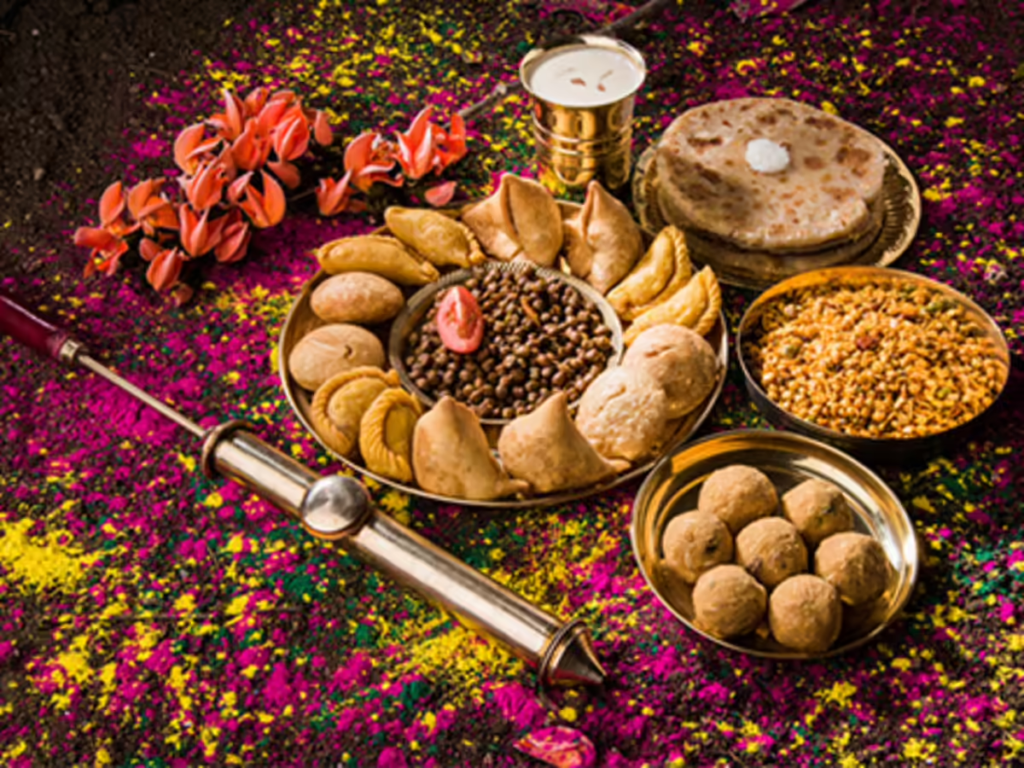
The festival temporarily relaxes social boundaries and encourages interaction across age groups and communities. While regional expressions differ, the symbolic foundation remains consistent. In the Terai, celebrations are shaped by Maithili and Bhojpuri songs, accompanied by dholak rhythms. Traditional foods such as malpuwa, selroti, and ghotta ( a preparation of bhang, milk, ghee, and butter) are prepared in households, alongside communal feasts. The musical and culinary traditions reinforce the communal character of the festival.
The Kathmandu Valley and the Chir Tradition
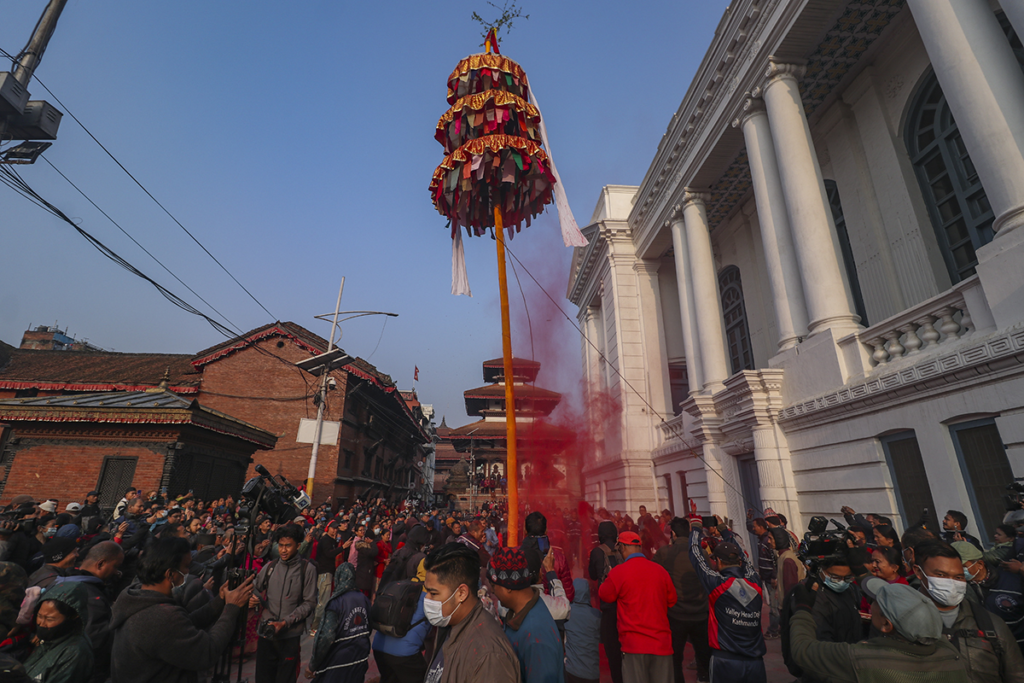
Within the Kathmandu Valley, Fagu Purnima includes the erection of a ceremonial bamboo pole known as the Chir at Basantapur Durbar Square near Kumari House. .
This is raised on Ashtami, the eighth day of the waxing lunar phase, a week before the full moon, by the Dhaalasiko Manandhars of the Newar community of Ason.Traditionally measuring around thirty-two feet, the bamboo pole is decorated with cloth (Chir Dhoja)in a tiered structure. A branch of the pomegranate tree, locally called dhaale, is incorporated into the installation. Portions of the branch are associated with ritual offerings near Guhyeshwari and Gorakhnath in Mrigasthali before final placement.
Historical accounts suggest that during the Malla period, Chir were erected at four key sites: the Mohan Hanumandhoka gate, Mohan Chowk within the Hanumandhoka premises, Gaddi Baithak, and Narayan Hiti Palace. Today, the primary installation remains at Basantapur, with continuation at Hanumandhoka.
On the evening of Holi, the Chir is taken down and carried along a traditional route through the old city from Makkhan, Indrachowk, Wotu, Mahabouddha, and Dhughabahi to Tundikhel, where it is burned in a ritual known as Chir Dahan. The burning symbolizes seasonal transition and ritual closure. Ashes were traditionally taken home for protection from evil.
While distinct to the Kathmandu Valley, the Chir Dahan symbolizes ritual closure and seasonal transition. Its decoration and subsequent burning represent the passage from one cycle to another.
Holi in India
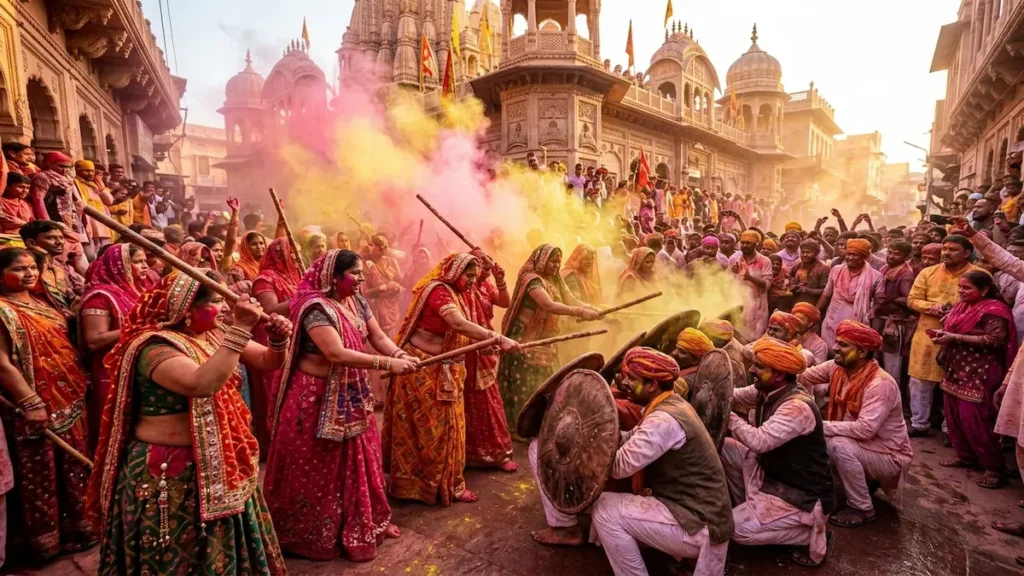
In North India, particularly in Mathura and the Braj region, Holi is closely associated with Krishna’s devotional traditions. Performative forms such as Lathmar Holi structure ritual play within symbolic social inversion. These regional expressions highlight the cultural and theological depth of Holi across geographic boundaries.
Holi is therefore not confined to a single national context. It represents a shared cultural expression across Nepal and India, reflecting historical exchange and regional adaptation.
Seasonal and Cultural Meaning
Fagu Purnima marks a transition in the agricultural calendar. The full moon of Falgun signals the arrival of spring, warmer days, and renewed cultivation cycles. Fire rituals, communal gathering, and the application of color collectively express release from the cold season and entry into a new phase of the year.
In Nepal, the period from mid-February to mid-March marks the shift from winter dryness toward spring warmth. Rhododendrons begin to bloom in the hills, skies clear, and agricultural preparation resumes. Wheat harvests conclude in some regions, and fields are prepared for subsequent crops such as maize and rice.
Traditionally, this seasonal shift was understood not only symbolically but physiologically.
Ritual Continuity and Material Change
The materials used during Holi have evolved over time. Historically, colors were prepared from plant-based sources such as turmeric, neem, and henna, substances associated with seasonal adjustment and Ayurvedic understanding. Their application corresponded with the climatic transition from winter to spring.
In contemporary urban contexts, synthetic pigments have largely replaced botanical preparations. While these offer greater visual intensity, concerns regarding skin sensitivity and environmental impact have prompted renewed interest in safer materials.
This shift in material does not alter the symbolic foundation of the festival. Rather, it illustrates how ritual practice adapts to changing conditions while retaining structural continuity.
Within Himalayan artistic traditions, color carries philosophical and symbolic meaning. In ritual context, it signifies transformation. The seasonal application of color during Holi therefore operates not merely as spectacle, but as a marker of transition in both environment and social life.
Featured Artwork
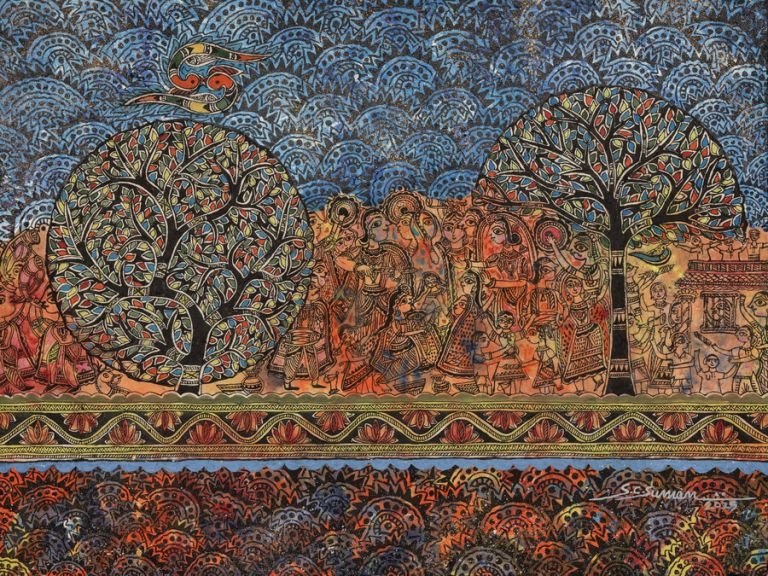
Mithila artist SC Suman
Acrylic on Nepali Paper
71 × 53 cm
Private Collection
Featured Himalayan Art Council-certified artwork by Mithila artist S.C. Suman enhances this reflection on Holi.
The painting frames Fagu/Holi within the ritual landscape of Janakpur. It situates celebration amid discipline, pilgrimage, and devotional continuity associated with the Mithila region and the Ramayana tradition.
Suman uses structured visual language typical of Mithila painting, where line defines form and color operates symbolically rather than illusionistically. Natural elements, musical instruments, and figures engaged in communal exchange are arranged in balanced registers, reinforcing order within celebration.
At the upper left, a pair of parrots known in Mithila iconography as latpatiya suga evokes love, fidelity, and marital harmony. In regional visual tradition, such motifs often allude to the sacred union of Ram and Sita and, more broadly, to social coexistence. Their placement layers relational meaning beyond the immediate scene of festivity.
The controlled interplay of line, color, and pattern gives the work coherence and philosophical depth. Holi Utsav uses color to express ritual continuity and collective identity within Mithila’s artistic tradition.
Conclusion
Fagu Purnima is more than a seasonal festival. It integrates lunar rhythm, scriptural memory, ecological awareness, and communal celebration. From the Chir ceremony in Kathmandu to the devotional traditions of Braj, Holi reflects shared yet regionally nuanced cultural heritage.
The festival demonstrates that color can achieve more than visual appeal. Color relates, symbolizes, and transforms. Through ritual, music, devotion, and gathering, Holi renews social bonds and seasonal awareness.
As we observe Fagu Purnima, it continues to carry memory, meaning, and continuity across generations.