
Key Takeaways
- The planetary week in Himalayan tradition structures ritual, governance, agriculture, and artistic production through cosmological timing.
- Rooted in classical Indian astronomy, drawing on texts such as the Surya Siddhanta, Tibetan Astrology, and the broader legacy of Babylonian, Greek, and Indic astronomical exchange, planetary days are preserved through the pañcāṅga and monastic calendars in Nepal and Tibet.
- Hindu and Buddhist philosophies interpret planetary forces differently, yet both integrate them into ethical and spiritual life.
- Elemental systems across India, Nepal, Tibet, and China shape how planetary days are understood and visually encoded.
- In Tibetan Vajrayana, notably the Kalachakra tradition, six elements, Earth, Water, Fire, Air, Space, and Awareness, underpin the cosmological framework.
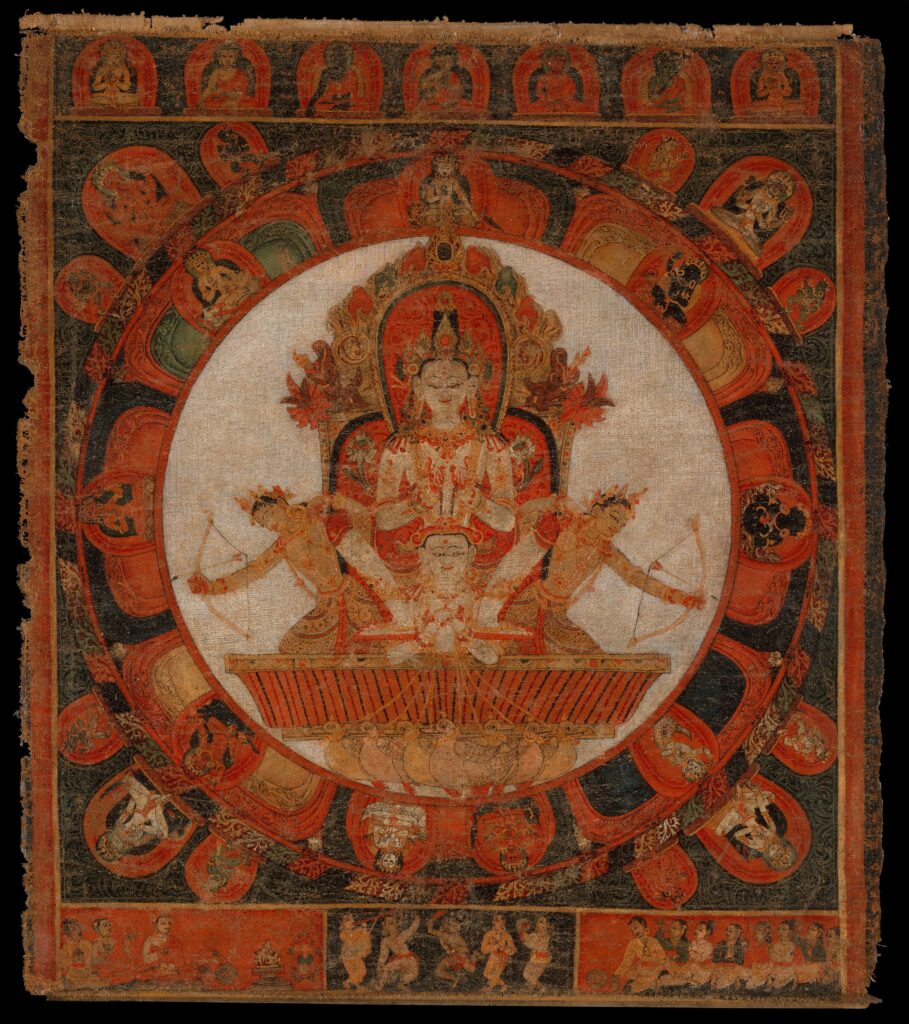
- Paubha and Thangka paintings translate celestial order into sacred geometry, color symbolism, and compositional hierarchy.
| English | Planet | Tibetan | Nepali | Hindi | Tibetan Element | Vedic Element |
| Sunday | Sun (Surya ) | Nyima | आइतबार/ रबिबार | रविवार | Fire | Fire |
| Monday | Moon (Chandra) | Dawa | सोमबार | सोमवार | Water | Water |
| Tuesday | Mars (Mangala) | Migmar | मङ्गलबार | मंगलवार | Fire | Fire |
| Wednesday | Mercury (Budha) | Lhakpa | बुधबार | बुधवार | Water | Earth |
| Thursday | Jupiter (Brihaspati) | Phurbu | बिहिबार/ गुरुबार | गुरुवार | Ether | Wind/Air |
| Friday | Venus (Shukra) | Pasangs | शुक्रबार | शुक्रवार | Earth | Water |
| Saturday | Saturn (Shani) | Penpa | शनिबार | शनिवार | Earth | Air |
Introduction
In much of the modern world, time is standardized, digital, and abstract. A Tuesday differs from a Thursday only by name. Yet within the Himalayan world, each day carries temperament and consequence.
The planetary week in Himalayan tradition is not merely calendrical. It is cosmological. Sunday embodies solar authority. Monday carries lunar fluidity. Saturday demands Saturnine restraint. Across India, Nepal, Tibet, and into parts of China influenced by Indic systems, these planetary associations shape ritual timing, state ceremony, agricultural decisions, and even artistic composition.
Understanding Himalayan art without understanding sacred time is to miss one of its structural foundations. The planetary week provides not only ritual instruction but visual logic.
To understand how, we must begin with the question of origins.
Origins of the Seven-Day Week
The seven-day week cycle is among the oldest continuously observed cycles. Ancient skygazers noted seven visible bodies that moved against the fixed stars: the Sun, the Moon, and planets Mars, Mercury, Jupiter, Venus, and Saturn.
From Babylon to Alexandria
The planetary week traces to ancient Babylonia/Sumer, where 1st-millennium BCE astronomers modeled planetary motion for time-keeping. From there, it spread to Hellenistic Egypt’s Alexandria, blending Babylonian, Egyptian, and Greek astronomical traditions.
Vettius Valens (b. 120 CE, Antioch), an astrologer trained in Alexandria, offers the oldest Greek attestation in his Anthologiarum (c. 150–175 CE). He lists the day order: Sun, Moon, Mars, Mercury, Jupiter, Venus, Saturn—the order matching to Himalayan weekdays.
Transmission to India: The Yavanajātaka
The planetary week reached India via Hellenistic interactions. The Yavanajātaka (‘Horoscopy of the Greeks’), attributed to Sphujidhvaja, is among the earliest Sanskrit texts referencing the planetary weekday system. Traditionally dated by David Pingree to a ~149–150 CE translation of a Greek Alexandrian original, newer analysis by Bill Mak (using fresh manuscripts) places it between the 4th–6th centuries CE. It shows Greek planetary weekdays entering India through Hellenistic routes and integrating into Sanskrit astrology.
Transmission to Tibet and China
From India via Silk Road trade and Buddhist transmission, the planetary week spread east. Chinese scholar Fan Ning (339–401 CE) provides the earliest reference, by late-4th-century presence. 8th-century Manichaean missionaries and monks Yi Jing/Amoghavajra spread it further via Central Asia and Indian Buddhism.
In Tibet, it arrived via Indian Buddhism, Central Asian Manichaeans, and 11th-century Kalachakra tantra, integrated into Bon and Tibetan Buddhist cosmology. Thus, the Himalayan planetary week day is a centuries-long synthesis of Babylonian, Greek, Indian, Tibetan, Chinese, and Central Asian traditions, reshaped by each culture’s cosmology.
Astronomical Foundations
Having entered the Indian subcontinent through earlier exchanges with Babylonian and Hellenistic astronomy, the seven-day planetary sequence was gradually integrated into classical Indian science. Its most refined form appears in the Surya Siddhanta (4th–10th centuries CE), a Sanskrit treatise that developed sophisticated models of planetary motion, eclipse calculation, and solar-lunar coordination, absorbing astral frameworks into South Asian cosmology.
Over time, astronomical calculation merged with jyotiṣa, a Vedic ritual astrological science that mediates between celestial cycles and human action. This synthesis gave rise to the pañcāṅga, the traditional lunisolar almanac still consulted across Nepal and India. The pañcāṅga integrates five components: Tithi (lunar day), Vāra (weekday), Nakṣatra (lunar mansion), Yoga (luni-solar configuration), and Karaṇa (half-tithi division).
Within this structure, each weekday is assigned planetary rulership, situating the seven-day cycle within broader lunar and stellar calculations. Sunday is designated Ravi-vāra, aligned with the Sun; Monday, Soma-vāra, aligned with the Moon. This system is not fatalistic. It does not eliminate agency. Rather, it conditions the quality of time, suggesting that certain activities harmonize more readily with particular planetary conditions.
In Nepal, pañcāṅga continues to guide temple rituals, festivals, agriculture, and life-cycle ceremonies. The planetary week thus operates not as an isolated inheritance but as an integrated element of Himalayan calendrical science regulating communal and sacred life.
The Synthesis of Tibetan Astrology (Tsi Rik)
The planetary week in the Himalayan context requires understanding of Tibetan astrology, Tsi Rik (rtsis rig) as Tibet integrated diverse cosmological traditions into a coherent science of time.
From indigenous Bon cosmology came concepts of directional force, elemental balance, and visible and invisible dimensions of reality, shaping spatial orientation and auspicious timing central to calendrical practice.
Chinese and Central Asian contacts introduced the sexagenary sixty-year cycle (animals cycle/elements) alongside numerical grids (mewa) and directional trigrams (parkha). These systems provide cyclical and spatial coordinates atop planetary-lunar calculations.
Similarly, Indian astral science in the form of Kalachakra Tantra, provided systematic astronomy: the seven-day planetary sequence, lunar mansion, eclipse calculation, and celestial motion linked to subtle physiology across external, internal, and transformative contemplative practice. Distinctively, it includes six elements: earth, water, fire, air, space, and awareness, placing consciousness within cosmological structure.
Underlying tsi rik is the Buddhist philosophical framework on ultimate emptiness (śūnyatā) and conventional appearances. Planetary influences operate at the conventional level, shaping conditions and tendencies, yet at the ultimate level they are empty of inherent existence, arising interdependently. This framework prevents fatalism. Planetary forces condition experience without determining it, while karma, intention, and practice remain transformative.
The result is neither purely Indian nor Chinese nor pre-Buddhist. It is distinctly Himalayan: a composite science of time blending planetary cycles, elemental theory, spatial orientation, and philosophical insight converge.
Elemental Structures of the Planetary Week
Elemental correspondences within the planetary week differ across Himalayan regions. These differences do not indicate contradiction but reflect distinct cosmological emphases.
In classical Hindu astrology, particularly within the tradition attributed to Brihat Parashara Hora Shastra, planetary elements are not codified in a single table. Instead, elemental associations emerge across dispersed descriptions of planetary nature, strength, temperament, and aspect.
For instance, Mars is consistently aligned with fire, Saturn with air, Venus with water, and Mercury with earth, while the Sun and Moon occupy more complex and sometimes supplemental positions depending on interpretive context. Here, the emphasis rests on the intrinsic elemental disposition (tattva) of each planet, shaping how it expresses within a horoscope.
In Tibetan astrology, elemental logic operates differently. Drawing from the Kalachakra Tantra and Sino-Tibetan cyclical theory, weekday–element correspondences vary by lineage and textual transmission. Some Kalachakra-derived systems align closely with Indian planetary models, while others integrate Chinese elemental cycles more visibly.
In many Tibetan practices, elemental qualities are attributed to the day as a temporal condition rather than solely to the planet as an inherent essence. The focus shifts from fixed planetary nature to contextual energetic manifestation within a broader cyclical framework.
Elemental philosophies across regions
Indian and Nepali cosmology is structured by the pañca-mahābhūta: Earth, Water, Fire, Air, and Ether. These five elements structure ritual appropriateness and cosmological balance. For instance, Fire-dominant days support purification and assertion; Water-dominant days encourage reflection and fertility; Air suggests movement; Earth suggests stability; Ether signals expansiveness and subtlety.
The Kalachakra tradition extends this model to six elements by incorporating awareness as a cosmological principle, affirming consciousness as structurally embedded within time itself.
Meanwhile, Chinese Five Phase theory: Wood, Fire, Earth, Metal, and Water, introduced an additional cyclical logic. As planetary systems moved across Inner Asia, selective correspondences were harmonized within Tibetan contexts without displacing Indic foundations.
In the Himalayan world, these elemental systems coexist. A planetary day may therefore be interpreted through intrinsic planetary character, calendrical condition, cyclical element, and ritual suitability simultaneously. The differences reveal not inconsistency but layered cosmological integration.
Hindu Perspective: Navagraha and Cosmic Order
Within Hindu philosophy, planetary deities form the Navagraha, nine celestial forces comprising Surya (Sun), Chandra (Moon), Maṅgala (Mars), Budha (Mercury), Bṛhaspati (Jupiter), Śukra (Venus), Śani (Saturn), and the shadow planets Rahu and Ketu.
Rahu and Ketu are not physical planets but the ascending and descending nodes of the Moon, the mathematical points where the lunar orbit intersects the ecliptic, generating eclipses. They are called chhāyā graha (shadow planets) in classical literature and carry profound karmic significance.
The philosophical principle underlying planetary observance is ṛta, cosmic order. Human action should align with celestial rhythm. Marriage aligns with Jupiter’s expansion. Conflict aligns with Mars’ force. Restraint aligns with Saturn’s discipline.
This alignment is not superstition. It is cosmological coherence.
The Seven Planetary Days: Ritual Conduct, Cultural & Visual Expression
In Himalayan calendrical culture, each weekday is shaped by a constellation of factors, including planetary rulership, elemental associations, associated deities, and broader calendrical calculations. These correspondences draw from classical Indian astral traditions, the pañcāṅga system, Tibetan calendrical science, and regional practices, forming a layered framework rather than a single fixed model.
Within this structure, weekday timing informs ritual observance, agricultural activity, temple ceremonies, artistic commissions, and daily conduct across Himalayan communities. Thus the planetary week functions as part of an integrated system in which cosmology, ethics, and cultural expression converge.
Sunday: Surya — The Sun
Sunday is governed by the Sun (Surya). Its element is Fire (Agni), symbolizing authority, vitality, and illumination. Solar energy is radiant, commanding, and expansive. It favors acts of consequence and visibility over quiet reflection.
Sunday is dedicated to Surya across Himalayan and Hindu traditions. Devotees observing Ravivar Vrat take a single meal before sunset, avoid salt and oil, and offer red flowers. Special attention is given to bodily and environmental cleanliness, and many give alms. The fast is believed to support vitality, fulfill wishes, and provide relief from skin ailments.
| Favorable | Less Favorable |
| Royal and official ceremonies | Judgments and peace treaties |
| Solemn exchanges and monastic ordination | Marriage and funeral rites |
| Festivals, art, and ornaments | Founding a temple |
| War and fire rituals | Moving house or selling possessions |
| Preparing medicines | Sowing seeds or surgical operations |
| Travel toward the North | Beginning writing or new projects |
| Acts of courage and authority | Travel toward the West |
Monday: Chandra / Soma — The Moon
Monday is governed by the Moon, known as Chandra or Soma. Its element is Water (Jala), and it influences the mind, emotion, and intuition. The Moon’s energy is cooling, reflective, and fluid. It favors inner work over outer confrontation.
In Hindu tradition, Monday is dedicated to Shiva, worshipped as Chandrashekhar, the moon-crowned one. The crescent moon resting in his matted locks symbolizes mastery over the fluctuating mind and cyclical time. Devotees observe this day through fasting, ritual bathing, offerings of water and bilva leaves, and evening prayers seeking mental clarity, harmony, and stability.
In the Āyurvedic and ritual traditions of Nepal and Tibet, lunar timing also governs the preparation of medicinal herbs as lunar plants are considered most potent when gathered or prepared on the Moon’s day. This connection between Monday, healing, and the cultivation of life-force runs through both the Hindu and Buddhist medical traditions of the Himalayas.
| Favorable | Less Favorable |
| Reflection, writing, and artistic practice | Violent or aggressive acts |
| Purification rituals and incense making | Excessive physical exertion |
| Temple building and sacred construction | Use of fire |
| Planting, irrigation, and healing practices | Travel, especially toward the East |
| Medicine preparation | – |
| Marriage, feasts, and sacraments | – |
| Settling into a new home | – |
Tuesday: Maṅgala — Mars
Tuesday is governed by Mars (Maṅgala). Its element is Fire (Agni), fueling courage, action, and bold transformation. Martian energy is sharp, penetrating, and forceful. It favors decisive action over contemplation, but demands discipline.
In Hindu tradition, Tuesday is associated with Ganesha and Hanuman. Both embody strength, protection, and the removal of obstacles. Their worship channels fiery energy toward courage, responsibility, and spiritual resilience rather than aggression. Regional traditions also honor Goddess Durga and Kali on this day, and in South India, Tuesday is often associated with Skanda/Muruga as the deity governing Mars.
| Favorable | Less Favorable |
| Taking on responsibility | Marriage and funeral rites |
| Rituals that dispel negativity | Trade and agricultural work |
| Fire rituals and protective rites | Planting, irrigation, and water-related activities |
| Moving into a new house | Medical treatment or administering remedies |
| Naming a child | Important land-related petitions |
| Travel toward the East | Travel toward the North |
| – | Letting cattle out to graze |
Wednesday: Budha — Mercury
Wednesday is governed by Mercury (Budha). Its elemental nature is understood differently across traditions. For instance, as Earth in the Hindu/Vedic system and as Water in the Tibetan framework. Yet both point toward the same planetary quality: the element of logic, precision, memory, and practical intelligence.
Mercury governs wisdom, communication, trade, calculation, and business prosperity. Wednesday carries analytical, diplomatic, and strategic energy. It is not a day of force, but of careful reasoning, precise negotiation, and intelligent continuity.
In Hindu tradition, Wednesday is associated with Vishnu, the preserver and sustainer of cosmic order. His steady, balanced nature reflects Mercury’s qualities of intelligence and maintenance rather than force. Some devotees observe Budhvar Vrat for 21 consecutive Wednesdays, seeking clarity in speech, financial stability, and harmony in relationships.
| Favorable | Less Favorable |
| Travel (except toward the North) | Marriage ceremonies |
| Trade and business | Preparing medicines |
| Agricultural work, planting seeds and trees (not ploughing) | Combat or aggressive action |
| Irrigation and water-related activities | Fire rituals |
| Starting construction | – |
| Naming a child | – |
| Funeral rites | – |
| Important petitions and administrative steps | – |
| Practice of astrology | – |
Thursday: Bṛhaspati / Guru — Jupiter
Thursday is governed by Jupiter (Guru or Bṛhaspati). Its element is Ether (Ākāśa) in the Hindu/Vedic tradition whereas Wind/Air (Vāyu) in the Tibetan. Both point toward the same quality: expansiveness, the outward movement of wisdom and virtue, the capacity to fill space with good.
In Vedic cosmology, Ākāśa is not an empty void but the intelligent, vibrating substrate of creation. Jupiter’s Ākāśa quality reflects his role as the great teacher: he does not impose but opens the space within which understanding can arise. Jupiter governs virtue, ethical responsibility, knowledge, and long-term stability.
In Hindu tradition, Thursday is associated with Bṛhaspati, the celestial teacher of the Devas and embodiment of sacred knowledge. As Guru, he represents guidance, morality, and spiritual authority.
| Favorable | Less Favorable |
| Performing virtuous acts | Working with wood (endangers future prosperity) |
| Marriage | Travel toward the South |
| Moving into a new house | Funeral rites |
| Naming a child | Starting a fight |
| Starting construction | – |
| Taking on responsibility | – |
| Trade and agricultural work | – |
| Preparing remedies | – |
| Important petitions and formal steps | – |
| Practice of astrology | – |
| Travel toward the West | – |
Friday: Śukra — Venus
Friday is governed by Venus (Śukra). Its element is Water (Jala) in the Hindu/Vedic tradition and Earth (Pṛthvī) in the Tibetan framework. Both interpretations illuminate different facets of the same planetary character: Venus as the flowing, fertile current of beauty and desire (Water), and Venus as the stable ground of material abundance and nourishment (Earth).
Venus governs refinement, harmony, abundance, and the cultivation of well-being. Its planetary period is regarded as especially fortunate. In Hindu tradition, Friday is dedicated to Shakti, the Divine Mother, worshipped as Mahalakshmi, Santoshi Mata, Annapurna, and Durga. Devotees observe Shukrawar Vrat, including the Solah Shukravar fast of sixteen consecutive Fridays, often eating only at night.
In Kathmandu, at Ason, Annapurna Ajima, an incarnation of Parvati and the mother of nourishment and prosperity, symbolized by the Kalash is especially venerated on this day.
| Favorable | Less Favorable |
| Travel (except toward the West) | Marriage ceremonies |
| Starting construction | – |
| Moving into a new house | – |
| Naming a child or a place | – |
| Trade and agricultural work | – |
| Planting trees | – |
| Surgical operations | – |
| Practice of astrology | – |
| Rituals that dispel negativity | – |
| Rituals honoring local deities | – |
Saturday: Śani — Saturn
Saturday is governed by Saturn (Śani). Its element is Air (Vāyu) in the Hindu/Vedic tradition and Earth (Pṛthvī) in the Tibetan framework. Both readings capture essential qualities of Saturn’s character: the invisible, pervasive pressure of karmic consequence (Air), and the dense, enduring weight of structural reality (Earth). Saturn is slow, heavy, and exacting. Thus, this is a day of caution rather than expansion.
Saturday is associated with Shani, the planetary deity who represents justice, limitation, accountability, and the results of past actions. His influence is slow, heavy, and exacting, not because Saturn is cruel, but because the weight of accumulated karma moves at the pace of Air through stone. It is a day of caution rather than expansion.
| Favorable | Less Favorable |
| Acquisitions (not to be left unattended) | Traveling, especially toward the East |
| Buying (not selling or transferring possessions) | Setting off to war or beginning conflict |
| Planting trees and seeds (not ploughing) | Work involving fire |
| Irrigation and water-related work | Building walls or constructing temples and stupas |
| Calculation, accounting, and practical planning | Solemn declarations, titles, ordination, or beginning a reign |
| Marriage (moderately favorable) | Ritual offerings and sacraments |
| Travel toward the South | Medical operations and preparing medicines |
| – | Long journeys |
| – | Ploughing land |
| – | Selling or disposing of goods or animals |
| – | Expenditures and gifts |
| – | Divination |
From Cosmology to Canvas
The planetary week in Himalayan tradition is not decorative theology. It shapes visual grammar and influences, color systems and spatial organization regarding direction.
Colors correspond to elemental and planetary logic. Gold is used for solar presence. White and blue for lunar qualities. Red for fire and martial energy. Black and deep tones for Saturnine gravity.
Composition follows cosmological hierarchy. Central figures represent the primary principle of the image, while surrounding forms express directional and planetary balance. Mandala layouts further encode spatial-temporal symmetry, aligning visual geometry with astronomical orientation.
Historically and even today, the creation and consecration of sacred images are scheduled according to auspicious days determined through traditional almanac systems.
The tradition described in this article is not archived. It is alive in the workshops of Patan, in the studios around Boudhanath, in the hands of artists who still work by the same cosmological logic explored here. The only way to experience that is to go. For everything you need to get there, airlines, routes, airports, and timing on TalkTravel’s guide to flying to Himalayan art destinations covers it all.
Himalayan art is therefore structured by sacred time, not separated from it.
Conclusion
The planetary week in Himalayan tradition reveals a worldview in which astronomy, philosophy, ritual, and art function as an integrated system. Rooted in classical astronomical science and shaped by centuries of exchange across Babylonian, Greek, Indian, Tibetan, and Chinese intellectual traditions, it developed through adaptation rather than replacement.
Across India, Nepal, Tibet, and regions influenced by Sino-Tibetan transmission, planetary cosmology continues to structure ritual timing, ethical conduct, and artistic creativity. Within this framework, Paubha and Thangka paintings do not merely depict divine forms; they encode calendrical order, elemental logic, and spatial hierarchy.
To understand Himalayan art is therefore to also understand sacred time as a cultural foundation, along with symbolic layers.
At the Himalayan Art Council, our work in research, documentation, and certification is grounded in this understanding of sacred heritage.
Explore our archive to deepen your engagement with the Himalayan visual legacy.
Explore our archive to deepen your engagement with the Himalayan visual legacy.
Find more travel guides, airline breakdowns, and destination content at talktravel spiritual travel guide stories or join the conversation with travelers who’ve already made the trip at talktravel.