
Artificial intelligence (AI) is increasingly being used in cultural heritage work, including cataloguing, documentation, risk assessment, and digital restoration. For Himalayan sacred art, these tools raise practical and ethical questions that institutions, collectors, and practitioners need to examine carefully.
This blog summarizes what AI-based tools can currently do in the context of Himalayan art conservation and provenance, where their limitations lie, and why those limitations matter for everyone working with this tradition.
Why Thangka Is Different
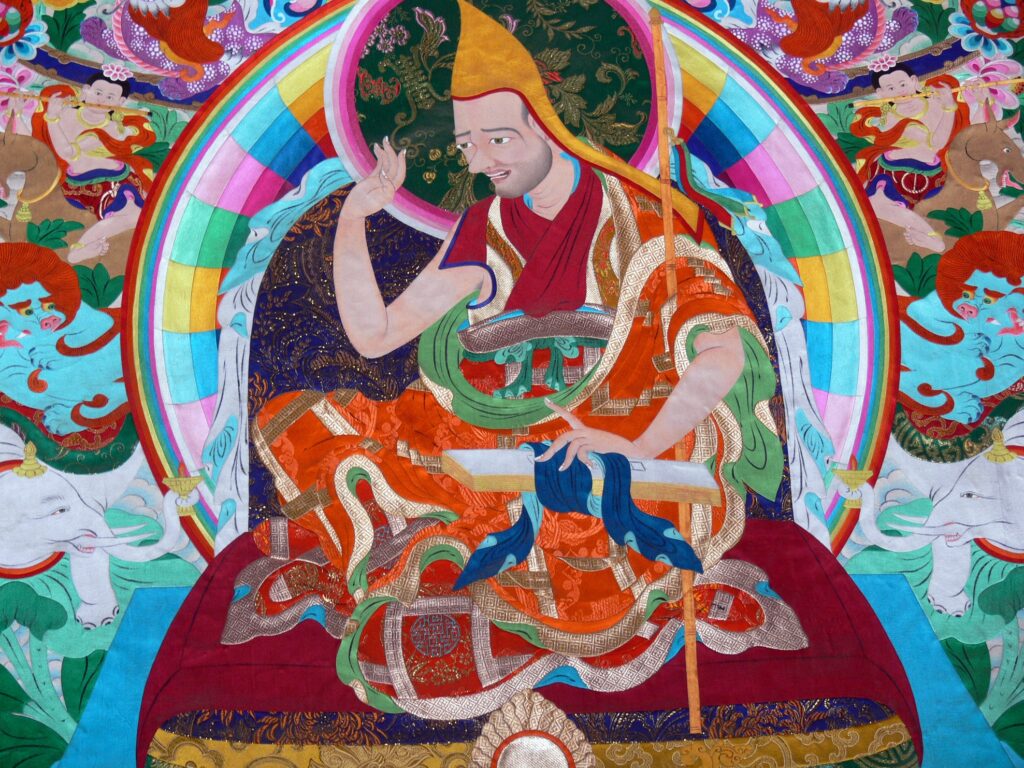
Thangka painters work on cotton or silk canvas using natural and mineral pigments. A well-maintained painting can retain its colours for generations, but physical durability is not what defines a Thangka. A Thangka carries a complete visual Buddhist theology. A deity’s posture, mudra, facial expression, attributes, colours, ornaments, and surrounding symbols are not aesthetic choices; they follow long-established iconographic conventions that shape meaning and devotional use.
Any conservator working on a damaged Thangka, whether human or assisted by software, faces a challenge with no direct equivalent in Western art restoration. Restoring a damaged canvas in a Western context requires skill and historical knowledge. Restoring a Thangka requires all of that and a working understanding of Buddhist iconography as well as the ability to distinguish regional stylistic variation.
The closely related Regong painting tradition from the Longwu River valley in Qinghai was inscribed on UNESCO’s Intangible Cultural Heritage list in 2009. UNESCO’s recognition reflects not only the importance of the paintings themselves, but also the need to safeguard the human knowledge required to create, interpret, and preserve them. In that sense, the crisis is as much about knowledge transmission as it is about material survival.
A Prior Question
Before examining what AI can do for Himalayan sacred art, practitioners and institutions need to address a prior question that technical discussions often skip. In Himalayan Buddhist tradition, does it make sense to restore a damaged Thangka at all?
The answer is genuinely complex. After consecration, a Thangka is not only a painting. It functions as a ceremonially active sacred object. In many traditional contexts, when a painting suffers severe damage, practitioners do not repair it. They retire it respectfully through ritual decommissioning and commission a master to paint a fresh work from the beginning. Restoration of a defaced sacred image carries spiritual and artistic incompleteness that a new work does not.
This shapes what responsible digital conservation actually aims for. Practitioners do not use these tools to make a centuries-old scroll look like a modern print. They use them to stabilize the digital record, supporting scholarly documentation, revealing underdrawings and inscriptions through non-invasive imaging, and preserving visual data without overwriting the physical history of the object. Digital tools should serve as a lens for seeing more clearly, not as a substitute for the painter’s brush.
What AI Can Do
The history of computational approaches to image restoration is shorter and less straightforward than popular accounts often suggest.
In the late 1990s and early 2000s, researchers including Marcelo Bertalmío developed mathematical techniques for filling damaged regions by extrapolating from the geometry of intact edges. These methods were useful on simple, uniform surfaces, but they were less effective for dense, rule-governed iconography such as Himalayan sacred art. A damaged deity form cannot be reconstructed safely from surrounding pixels alone, because correct inference depends on doctrinal knowledge that lies outside the image.
Later patch-matching algorithms and generative neural networks improved visual plausibility, but they introduced a different problem. They can produce outputs that look coherent without being iconographically correct. A model trained only on images may generate a statistically plausible mudra or facial form, but it cannot determine which form is required for a specific deity in a specific ritual context.
Current research is therefore shifting toward tasks where AI can add real value.
Classification and cataloguing
Computer vision systems can scan large uncatalogued collections, identify deities, compositional structures, and stylistic features, and generate descriptive metadata at scale. For institutions holding thousands of unprocessed works, this can dramatically improve access for researchers and curators.
Semantic captioning
Researchers are also developing AI models that generate contextually informed descriptions of Thangka imagery. These tools can support museum documentation and help make collections more searchable, even when they have not yet been systematically catalogued by specialists.
Pose and geometry analysis
Standard pose-estimation models are trained on ordinary human figures, so they struggle with multi-armed, multi-headed, or wrathful sacred figures. Specialised research is beginning to address the geometry specific to Himalayan iconography.
Non-invasive documentation
Multispectral imaging, infrared reflectography, and photogrammetry allow conservators to reveal underdrawings, hidden inscriptions, and earlier paint layers without intervening the physical object. AI tools can then help process, compare, and interpret the resulting data.
What AI cannot yet reliably do is generate iconographically trustworthy restorations of damaged sacred imagery. The obstacle is not simply computational power. It is the gap between statistical pattern recognition and rule-based doctrinal knowledge. More data and more computing power do not, by themselves, close that gap. Doing so would require systems that integrate visual analysis with iconographic textual sources, and that remains an active area of research.
Provenance and Attribution
A more immediate and tractable problem exists in the contemporary art community, and digital tools are beginning to address it directly.
In Thangka and Paubha traditions, meticulous copying is often part of artistic training rather than forgery. A student copy can be a sign of technical mastery within the workshop tradition. But that same practice creates difficulty in international markets, where a high-resolution image of a new masterwork can enable highly accurate copies to circulate before the original has been formally documented. Buyers can then struggle to distinguish a master’s work from an accomplished student version.
Digital documentation can help address this problem. When detailed artist records, high-resolution images, and tamper-evident digital records are created at the point of creation, institutions can establish verifiable provenance before a work enters a market where attribution becomes harder to resolve.
What HAC Is Doing
The Himalayan Art Council is building documentation infrastructure for this purpose. The system links artist records with high-resolution documentation of works, creating a verifiable record that supports certification and provenance checking. It is designed to strengthen attribution and protect artists in international markets.
The Council is also exploring distributed digital systems to make those records durable and resistant to alteration. This work is focused on documentation rather than speculation. In parallel, it is beginning early-stage collaboration with AI researchers on classification and cataloguing tools that may eventually support curators, scholars, and artists more efficiently.
The Role of Human Expertise
AI tools face a fundamental limitation when applied to Himalayan sacred art. They are trained on visual data, but they do not possess the doctrinal and textual knowledge systems that determine what these images mean and how they should be made.
That is why the most responsible use of AI in this field is supportive rather than substitutive. Digital systems can save time and improve access for documentation, provenance verification, and record-keeping, while trained practitioners must remain central to iconographic interpretation and restoration decisions.
For HAC, this understanding shapes how we approach technology: we focus on tools that support documentation, provenance verification, and systematic record-keeping, because those are the areas where digital systems can deliver immediate value to artists, collectors, and institutions.
The deeper work, however, belongs to all of us. If Himalayan sacred art is to remain meaningful for future generations, it will require not only better tools, but also informed viewers, responsible institutions, and a community willing to value and protect the knowledge behind the image.