
The Himalayan Art Council launched at Patan Museum in May 2025 with fifty artists and fifty artworks. The inaugural exhibition focused on classical traditions of Thangka, Paubha, and Mandala. It was not conceived as a showcase but as the beginning of a record.
Nepal holds one of Asia’s most sustained living art traditions of Thangka, Paubha, and Mandala. These artists work within iconographic and iconometric systems that have remained largely intact across centuries. They also maintain devotional and compositional standards passed through lineages of masters.
Similarly various folk art has also flourished among generations in diverse indigenous groups including a growing contemporary scene across diverse mediums. What has been absent, for most of this history, is a reliable infrastructure for documenting that work: who made it, when, under what lineage, and how it has moved through the world.
Without such records, attribution erodes. Provenance gaps accumulate. Ownership becomes difficult to verify, and artistic lineages become harder to reconstruct.
HAC was established to build that infrastructure. A system that records artist identities, work details, lineages, and formal ownership transfers through a cryptographically secured registry. Each record is stored on IPFS, a decentralised backup system, ensuring the archive persists independently of any single platform.
Where Things Stand
By May 2026, HAC had listed 131 artists across all genres of Nepali art, documented 240 works, onboarded eleven collectors with formally recorded holdings, and issued sixteen provenance certificates representing complete chains of custody.
| 131 Artists In the Registry | 240 Artworks Listed | 16 Provenance Certificates Transferred |
These figures represent the first year of a long-term archival effort. Nepal’s artistic practice extends across small towns, family studios, and rural workshops whose work has rarely entered any formal record. The registry is designed to reach those contexts over time. This suggests that the scale of the task ahead is considerably larger than what year one has addressed, and that the most consequential expansion of the archive is still to come.
What the Certificates Represent
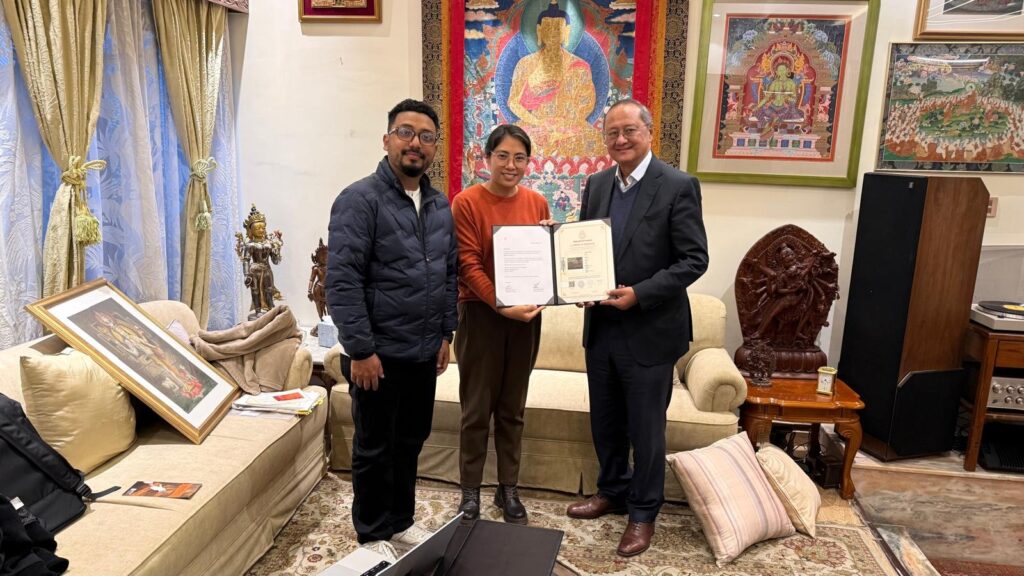
Each of the sixteen certificates issued in 2025 documents a formal transfer of ownership between a verified artist and a named collector. The artist’s authorship is permanently on record. The collector holds documented proof of what they own.
When a certified work transfers again, the record travels with it. Each subsequent transaction extends the chain of custody rather than starting from nothing.
This is the practical foundation of trust in collecting: verified documentation, not assumption.
The significance is concrete. Himalayan art represents an ancient and technically demanding tradition, and the contemporary Nepali art scene is producing serious work across mediums. What has currently complicated collecting these artwork is the absence of reliable provenance. A documented work carries verifiable information about its origin, its maker, and its ownership history. This reduces the risk of misattribution, supports accurate valuation, and creates a transferable record that holds its value through resale.
For institutions, the same principle applies at a greater scale. Museums, foundations, and university collections that acquire Himalayan art without documented provenance inherit unresolved questions about authenticity and ownership. HAC’s certification process provides institutions with the evidentiary basis needed to collect responsibly and to build holdings that can withstand scholarly and legal scrutiny over time.
What the First Year Revealed
HAC began with classical Himalayan forms because those traditions carried the most immediate risk of misattribution and uncredited circulation. By the end of a year, the registry had expanded to cover all genres of Nepali art. This reflects a recognition that the need for documentation is not specific to any one tradition. Contemporary artists face the same structural vulnerabilities as classical practitioners: work that circulates without verified attribution, and careers that lack a permanent public record.
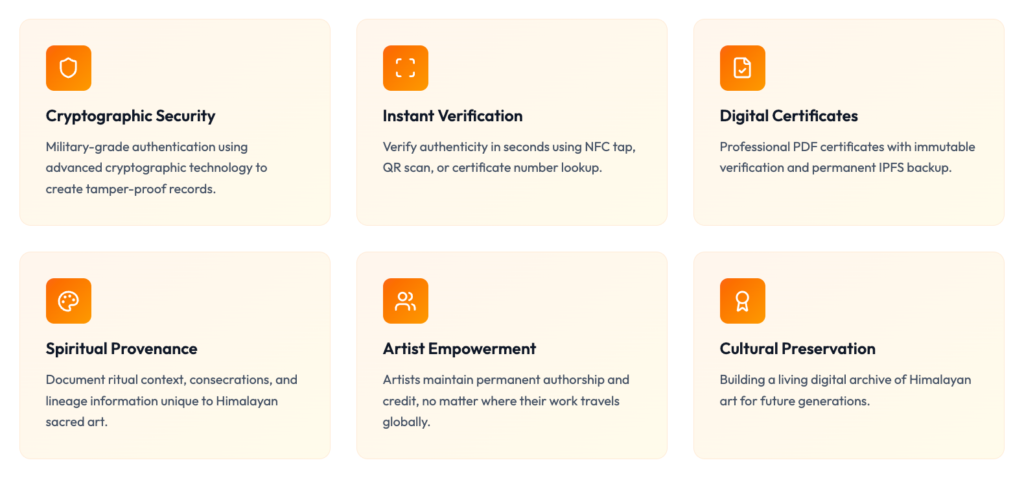
The first year also clarified the relationship between technical infrastructure and institutional trust. The verification system, including cryptographic sealing, IPFS backup, and QR and NFC certificate authentication, was functional from launch. What takes longer to build is the pattern of consistent, careful decisions that gives a registry its credibility. HAC’s curatorial team reviews each submission for documentation completeness and cultural accuracy before any record is sealed. That process is deliberate. The integrity of the archive depends on it.
With Gratitude
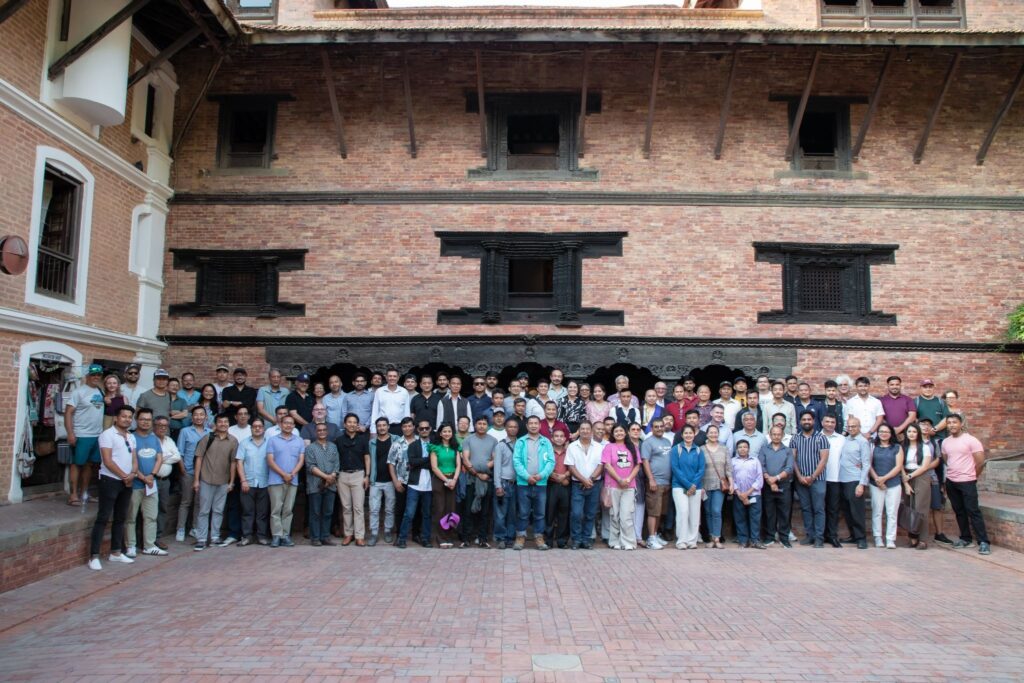
HAC was made possible through the convergence of institutional goodwill, individual generosity, and the conviction of a founding team that believed this work was worth undertaking. We remain deeply grateful to the Nepal Academy of Fine Arts and the then team, whose early support gave Himalayan Art Council credibility within the artistic community and made its formative outreach possible.
We also acknowledge the inaugural exhibition held at Patan Museum in May 2025, whose cultural setting helped define the spirit of the initiative and set a meaningful tone for what followed. Our sincere thanks go to Kailash K. Shrestha for his consultative guidance during the early stages, which shaped several of the structural decisions that continue to support HAC today.
We are equally indebted to the technical team, whose work built and continues to refine the platform; to the artists who trusted the process first; to the collectors who formalized their holdings; and to the curatorial team, whose careful reviews established the precedent on which the registry now rests.
A Shared Record
HAC registry is designed as a public, permanent record of Himalayan art and the artists. It is not a curated selection or a private database. Its value grows in proportion to its completeness, and its completeness depends on the participation of artists, collectors, and institutions across the full breadth of the field.
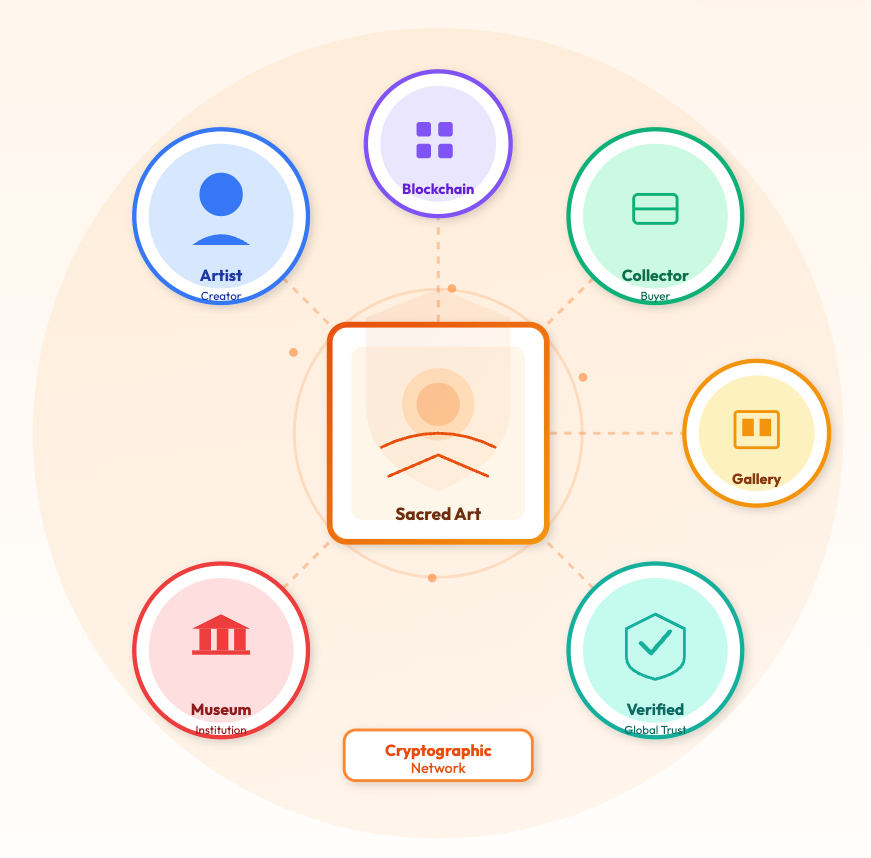
An artist who submits their biography, training lineage, and body of work contributes to a record that will outlast any individual exhibition or gallery relationship. A collector who documents their holdings creates a provenance chain that benefits every future owner of those works. An institution that engages with the registry adds authority to the proposition that verified documentation is a standard worth upholding.
The 131 artists currently listed represent the beginning of a much larger record. The tradition of Himalayan art, classical and contemporary, deserves to be documented in full. We record history so that attribution does not depend on memory alone.
The archive grows stronger with every record it holds. Artists, collectors, and institutions are invited to contribute.